How to Make Your Website Future-Proof: AI Search, Accessibility, Performance, and Compliance
A future-proof website is not a website that never changes, but one built to change quickly, safely, and cost-effectively.

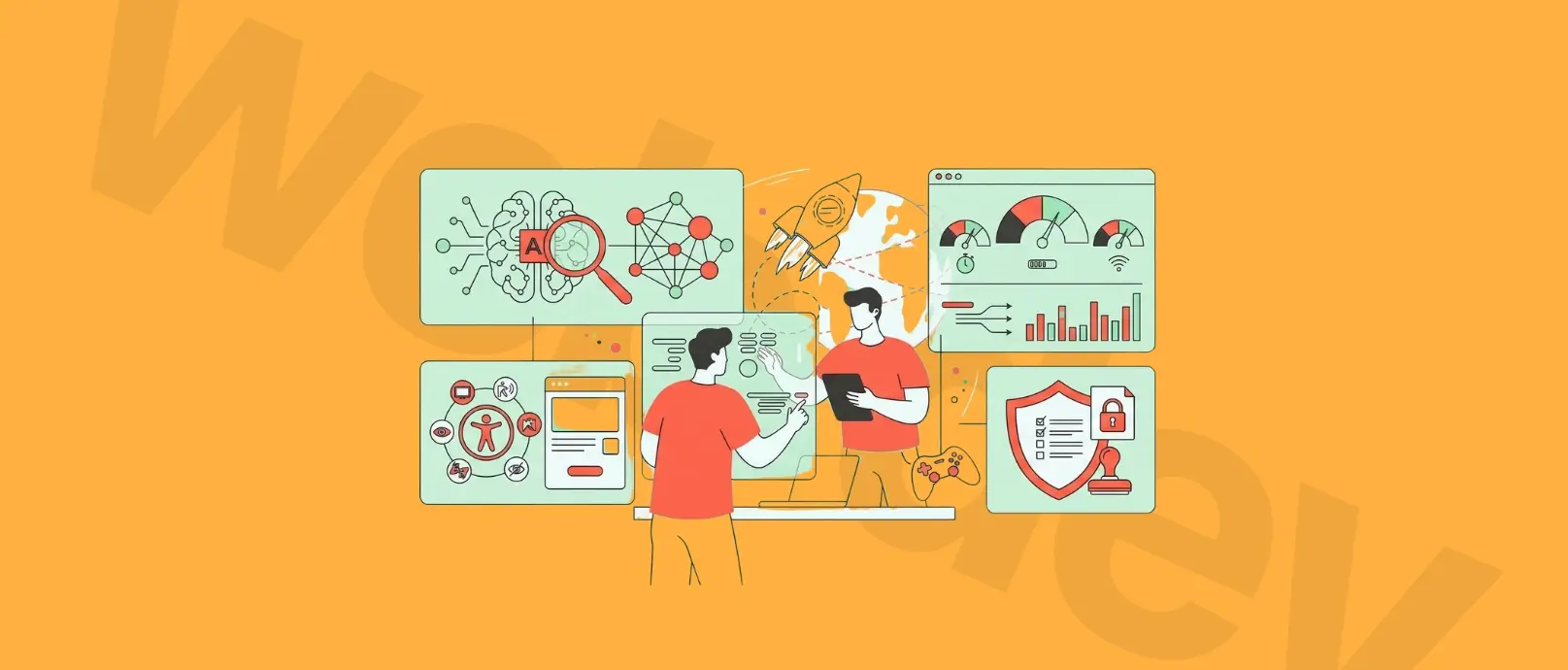
For businesses, future-proofing means moving away from rigid monolithic platforms and toward a modular digital foundation built on:
composable systems
API-first design
structured content
AI-ready integrations
This matters because over the next five years, your website will need to do more than publish pages. It will need to connect with CRMs, commerce engines, ATS platforms, customer portals, analytics tools, conversational interfaces, and agentic AI systems.
If your current platform makes each new integration or feature feel expensive, risky, or slow, the issue is probably not your team, but your architecture.
TL;DR
Search is moving toward conversational, multimodal, answer-first experiences. Google says AI Mode is designed for harder, multi-part questions and follow-up prompts, and Search Live is now expanding across more than 200 countries and territories with voice and camera input.
Accessibility is no longer just a UX hygiene topic. W3C updated the WCAG 3 Working Draft in March 2026, while the European Accessibility Act is already in effect for key products and services, including ecommerce.
Governance is now active, not theoretical. The EU AI Act already has provisions in force, GPAI obligations already apply, and the broader framework becomes fully applicable on 2 August 2026, with some exceptions.
Leaner, cleaner websites now do triple duty: they improve user experience, help machine readability, and support sustainability goals.

Find your biggest technical risks
Spot the weak points in your current setup before they slow down the business further.
What does it mean to future-proof a website?
Future-proofing means building a digital presence that can keep delivering value even when the environment changes.
That environment is changing on at least six fronts at once:
how people search
how machines read content
how interfaces are delivered
how fast experiences are expected to perform
how regulators evaluate digital services
how security and sustainability are measured
Why legacy monolithic websites are a growing business risk
Many older websites still function well enough on the surface. Pages load. Content gets published. Forms work. But beneath that surface, the platform may be limiting growth. That is especially true when the website runs on an aging, tightly coupled stack.
For marketing and digital teams, that often shows up as:
slow campaign launches
painful redesign cycles
integration delays
dependency on developers for routine changes
rising maintenance costs
difficulty adding new channels or tools
In other words, the website still works, but it no longer keeps up.
| Architectural feature | Legacy monolithic systems | Composable MACH architecture (2026) | Strategic advantage for future-proofing |
|---|---|---|---|
| Content delivery | Tightly coupled templates restricting output formats. | Omnichannel API-first distribution. | Content is created once and deployed across infinite digital endpoints seamlessly. |
| Scaling capability | Vertical scaling, highly prone to single-point bottlenecks. | Distributed, cloud-native microservices. | Granular scalability prevents localized traffic spikes from collapsing the entire system. |
| Technology stack | Vendor-locked, rigid proprietary frameworks. | Best-of-breed component orchestration. | Front-end freedom enables the rapid adoption of modern, performant frameworks (e.g., Next.js, Nuxt). |
| Market adaptation | Slow deployment cycles requiring massive codebase overhauls. | Agile, modular API-driven integration. | Rapid, low-friction integration of emerging touchpoints, such as voice search and AR/VR. |
1. Search has changed, and most websites have not
This is the first thing business leaders need to hear clearly: your website is no longer competing only for clicks on a classic results page. It’s competing to be understood, extracted, summarized, and cited inside AI-driven search experiences.
That means the old playbook of “one keyword, one page, one ranking goal” is no longer enough.
Search systems are increasingly breaking a question into sub-questions, checking multiple data sources, and looking for content that is structured, credible, and easy to synthesize. In plain English, your site now needs to answer questions the way a strong expert would answer them on stage: clearly, directly, with context, and without making people work to find the point.
2. The winners will treat content like infrastructure
Most companies still publish content as if every page were a self-contained island. That is expensive, fragile, and increasingly outdated.
A future-proof website treats content as reusable business infrastructure. Product information, service descriptions, pricing logic, FAQs, use cases, trust signals, case studies, and policy content should be structured so they can travel across channels cleanly.
| Search paradigm | Primary objective | Algorithmic focus | Success metric |
|---|---|---|---|
| Traditional SEO (pre-2024) | Ranking URLs on page one of SERPs. | Keyword density, backlink volume, click-through rates. | Organic traffic volume and SERP position tracking. |
| Generative Engine Optimization (GEO) (2026) | Securing citations within AI-synthesized responses. | Semantic relevance, Earned Media authority, verifiable first-party data. | Inclusion as a trusted source in LLM outputs; AI-driven referral traffic. |
More: GEO vs SEO: What Growing Brands Need to Change
This matters because your website is no longer the only destination. The same content may need to work on your site, in search snippets, in AI answers, in mobile experiences, in partner integrations, and in future interfaces you have not fully planned for yet. If the structure is weak, every new channel adds friction.
3. Accessibility is now market access
A lot of companies still talk about accessibility as if it were a delayed legal problem or a niche design conversation. That mindset is obsolete.
W3C updated the WCAG 3 Working Draft in March 2026 and makes clear that WCAG 3 has broader scope than WCAG 2, a different conformance approach, and stronger attention to wider user needs, including cognitive accessibility. At the same time, W3C also says WCAG 3 is still an incomplete draft and will not replace WCAG 2 for several years.
That is an important nuance: the direction is changing, but you don’t need to wait for a final standard to start doing the obvious things better.
So what should business leaders push for immediately?
Use semantic HTML. Make forms understandable. Ensure keyboard navigation works. Fix contrast and focus states. Write useful alt text. Reduce confusing layouts. Remove needless interaction friction.
They improve usability for more people, reduce abandonment, and make your content clearer for machines as well as humans.
4. Performance and sustainability are now part of the same conversation
Fast websites usually win more trust. They are easier to use, cheaper to operate, and easier for machines to process.
Smaller assets, fewer wasteful scripts, cleaner code, smarter caching, better image handling, and more deliberate media usage are not just technical polish. They improve performance and reduce digital waste at the same time.
5. Governance and security have moved closer to the homepage
The modern website is no longer just frontend code and analytics tags. It may include chat experiences, recommendation engines, personalization, AI-generated assets, automated workflows, third-party APIs, and region-specific data handling rules. That changes what future-proofing means.
For business teams, the takeaway is simple. If your website uses AI in any meaningful way, governance cannot live only in legal or security. It has to be part of digital strategy. Teams need visibility into where AI is used, what data it touches, what vendors are involved, what disclosures are required, and how risk is monitored over time.
6. What smart companies should do in the next 90 days
First, audit your top revenue and trust pages for AI readability. Look at headings, definitions, FAQs, schema, authorship, citations, and clarity.
Second, review accessibility on your most important journeys. Start with navigation, forms, checkout, account access, and support content.
Third, cut waste from the stack. Remove low-value scripts, optimize media, review third-party tags, and tighten performance budgets.
Fourth, map every AI-assisted feature and content workflow. Know where AI is used, what rules apply, and who owns governance.
Fifth, pressure-test your architecture. Ask whether your current CMS and delivery model can support reuse across web, AI, mobile, and future channels without rebuilding the same logic again and again.
What “future-proof” means for a B2B website with a 5-year horizon
A five-year website strategy should not focus only on design trends, but also on business adaptability.
A future-proof B2B platform should be able to:
support new buyer journeys
integrate with changing business systems
scale content and functionality independently
adopt new channels without a full rebuild
support AI-driven search, support, and qualification
evolve with hiring, commerce, and operations needs
The real goal is optionality. You want a platform that gives your business room to move. The MACH Alliance frames this modern model around microservices, API-first, cloud-native, and headless principles, all designed to improve flexibility and reduce dependence on all-in-one legacy systems.
The three pillars of future-proof web architecture
1. Headless architecture
Headless architecture separates the frontend from the backend.
Why it matters
Your content and business logic can power multiple experiences without being locked into one presentation layer.
Business benefit
You can redesign the website, launch a portal, or add a new interface without rebuilding the whole system.
2. Composable architecture
Composable architecture uses modular components instead of one large, tightly coupled system.
Why it matters
You can replace or improve one capability without ripping apart the whole platform.
Business benefit
You avoid expensive replatforming cycles and gain more control over how your stack evolves.
3. API-first design
API-first design means integrations are considered from the beginning, not added as an afterthought.
Why it matters
Your website becomes easier to connect to CRMs, ERPs, ATS platforms, personalization engines, and AI systems.
Business benefit
You reduce integration friction and make future tools faster to adopt.
Is your website architecture slowing down growth?
Build a platform that supports faster launches, better integrations, and stronger lead generation.
Why AI changes the future-proofing conversation
A website is no longer just a set of pages for humans to browse. It’s becoming a structured environment that AI systems will search, interpret, and act on.
That includes:
conversational product discovery
lead qualification assistants
support copilots
internal knowledge retrieval
agentic workflows across systems
OpenAI’s current platform direction reflects this shift, with APIs and tools designed for retrieval, function calling, web search, tool use, and agentic applications.
That means future-proofing is now partly about making your website machine-usable, not just visually appealing.
What makes a website LLM-friendly?
An LLM-friendly website is easier for AI systems to understand, retrieve from, summarize, and cite accurately.
That usually means:
clear heading hierarchy
focused sections with one main idea each
explicit definitions
consistent terminology
structured FAQs
well-labeled products and services
schema markup where appropriate
content blocks that are reusable across channels
Google’s documentation on structured data reinforces the same larger principle: structured, explicit information helps systems understand content more reliably.
Practical examples of future-proofing in B2B
Example 1: adding a conversational assistant
If your product, content, and support information are available through clean APIs and structured content models, it’s much easier to deploy an AI assistant that gives useful answers.
Example 2: integrating with a headless ATS
If your careers section needs to connect directly with a platform, API-first architecture makes that feasible without awkward workarounds. Platforms publicly provide developer resources and API references, which shows the broader direction enterprise platforms are taking.
Example 3: launching a partner or customer portal
A headless, composable setup lets you reuse core business logic while building a completely different frontend experience for another audience.
Example 4: replacing one tool without replacing everything
If your CMS or search layer no longer fits, a composable stack gives you the option to swap it without rebuilding the entire website.
Signs your current website is not future-proof
Your website may already be showing signs of architectural strain if:
every redesign takes too long
integrations are custom and brittle
business teams rely heavily on developers for basic changes
content is difficult to reuse across channels
adding new experiences feels risky
technical debt blocks experimentation
AI use cases feel out of reach
What a future-proof B2B website should be able to do
A strong platform should be able to:
launch new digital experiences quickly
support multiple frontends
integrate with modern business systems
structure content for search engines and LLMs
support AI assistants and automation workflows
scale without major architectural rework
reduce long-term maintenance friction
Key takeaway for decision-makers
Future-proofing is not about guessing the next trend correctly, but about building a website architecture that makes future change cheaper, faster, and safer.
That is the real competitive advantage.
If your website cannot easily adapt to headless experiences, modular services, API-driven integrations, and AI-enabled workflows, then the risk is not theoretical. It is already operational.
The good news is that future-proofing doesn’t require predicting the future perfectly, but building for change. Need help with future-proofing your website architecture? Contact us and see what is holding your website back.
FAQ
Modern Web Development Explained
It means designing the website so it can evolve with new technologies, channels, and business needs without requiring a complete rebuild.
Because they make change harder. When content, frontend, business logic, and integrations are tightly coupled, every update becomes slower, riskier, and more expensive.
Headless separates the frontend from the backend. Composable takes that further by making the wider platform modular, so individual services can be selected, replaced, or combined over time.
Because modern websites need to connect to more systems than ever before. API-first design makes that easier, faster, and more sustainable.
Because architecture determines how quickly the team can launch campaigns, test ideas, personalize experiences, connect tools, and respond to market changes.
Clear headings, concise sections, explicit definitions, structured FAQs, consistent terminology, and machine-readable structure all make content easier for AI systems to interpret and retrieve.
Yes. Many businesses modernize in phases by decoupling the frontend, improving integrations, restructuring content, and replacing selected components over time.
That depends on the company, but common examples include CRM, ATS, ERP, analytics, marketing automation, support platforms, AI systems, and customer-facing portals.
Usually when change becomes too slow, maintenance keeps getting more expensive, integrations are painful, or the website starts blocking business priorities instead of supporting them.
See what is holding your website back
Uncover the architectural issues slowing growth and making change harder than it should be.