Website Redesign Cost and Timeline: What Growing Teams Should Expect
Website redesign costs for growing companies typically range from $10,000 for a light visual refresh to $75,000+ for a full replatforming. Timelines run 4 weeks to 6+ months. The main cost drivers are CMS limitations, content migration scope, integration complexity, and internal approval cycles, not design work alone.


What affects website redesign cost and timeline most?
The biggest variables are redesign scope, CMS limitations, existing technical dependencies, and internal approval cycles. A website redesign checklist helps surface these before work begins.
How does redesign scope affect cost and timeline?
The scope of the redesign has the biggest impact on budget and delivery time.
Some projects focus on visual updates and UX improvements while keeping the current CMS, page structure, and frontend architecture. Others involve rebuilding templates, restructuring navigation, migrating content, or introducing new functionality across the site.
During review, teams routinely find outdated templates, content that no longer fits the new structure, and integrations that need reworking before implementation can begin
This is one of the main reasons redesign projects expand over time. Research shows that 78% of software projects experience scope creep, with changing requirements remaining one of the biggest drivers behind budget overruns and schedule delays.
Clear prioritization early in the process helps reduce timeline risk and unnecessary development work.
When does your CMS become a redesign blocker?
The current CMS determines how flexible the redesign process is.
Older platforms may create limitations around component reuse, content modeling, localization, publishing workflows, or integrations. In some cases, the redesign gradually turns into a larger replatforming initiative because the existing system can no longer support the company’s publishing and scalability requirements.
This has become increasingly common. Storyblok’s State of CMS report found that 68% of CMS users migrated to a new CMS within the last three years. Content scalability and technical limitations were among the most common reasons behind those decisions.
The warning signs are usually operational:
slow publishing workflows,
inconsistent templates,
developer dependency for content changes,
fragmented systems,
difficult integrations.
Left unaddressed, these slow down the redesign and every content update after launch.

Comparing Payload, Storyblok, Sanity, Strapi and more?
Our 2026 CMS report covers real-world use cases, trade-offs and ROI.
How do integrations and SEO add to redesign cost?
Analytics platforms, CRMs, consent tools, localization services, ecommerce functionality, search systems, and third-party APIs all add implementation and QA requirements during a redesign.
SEO protection during redesign also requires dedicated planning. Redirect mapping, metadata preservation, analytics continuity, and internal linking audits all add work that is often underestimated at the beginning of the project.
The risk is significant. Traffic losses of about 40% are documented after structural changes go live without redirect mapping, which is why technical audits on larger projects happen before design work begins
How do internal approvals slow down a redesign?
Feedback loops, approval structures, and competing stakeholder priorities can slow projects even when design and development work are progressing normally. Delays appear during content reviews, legal approvals, or discussions around navigation, messaging, and feature priorities.
Add marketing, sales, product, leadership, and external partners, and conflicting expectations will slow the project even when technical work is on track.
Clear ownership and shorter review cycles are the most practical tools for keeping a redesign on schedule.

An experienced redesign team sees complexity earlier
Work with experts in website redesigns, CMS migrations, and scalable frontend architecture.
Typical website redesign cost ranges for growing teams
For growing companies, redesign scope falls into three tiers, and cost scales with technical complexity, not page count.
| Redesign type | Typical scope | Estimated cost | Typical timeline |
|---|---|---|---|
| Light redesign | Visual refresh, UX improvements, selective template updates | $10,000-$15,000+ | 4-8 weeks |
| Mid-scope redesign | Content restructuring, CMS customization, SEO improvements, partial frontend rebuild | $15,000-$30,000+ | 2-4 months |
| Complex redesign | Replatforming, headless architecture, integrations, large-scale migration | $30,000-$75,000+ | 4-6+ months |
Light redesign
A light redesign focuses on visual updates, UX improvements, and selective template changes while keeping the current CMS and site architecture in place.
These projects include:
refreshed UI components,
updated typography and visuals,
homepage redesign,
landing page improvements,
minor content restructuring,
performance optimization,
basic SEO improvements.
Light redesign projects for growing companies often start around $10,000-$15,000, depending on the number of templates, content requirements, and implementation complexity.
Because the underlying platform remains largely unchanged, implementation timelines are shorter and technical complexity stays relatively manageable.
This type of redesign is the right fit when the existing CMS still supports the company’s publishing and operational needs.
Mid-scope redesign
Mid-scope redesigns involve structural changes across both design and content.
The project may include:
navigation restructuring,
new page templates,
updated content models,
expanded SEO work,
CMS customization,
integration updates,
partial frontend rebuilds,
multilingual or localization improvements.
This is the stage where hidden complexity starts appearing. Teams discover outdated content, inconsistent templates, technical dependencies, or workflow limitations that were not visible at the beginning of the project.
Industry benchmarks place many mid-scope redesigns in the roughly $15,000-$30,000 range, depending on platform complexity, integrations, and content requirements. Timelines commonly extend into the 8-12 week range.
Two sites with the similar page count can have completely different implementation costs depending on how maintained the existing platform is.
Complex redesign
Complex redesigns typically cost $30,000–$75,000+ and run 4–6 months or longer. They combine visual redesign with larger technical changes:
replatforming,
ecommerce restructuring,
custom integrations,
advanced localization,
frontend rebuilds,
large-scale content migration,
analytics and tracking reconfiguration,
accessibility remediation,
performance optimization across multiple systems.
At this stage, the redesign starts affecting content workflows, integrations, and long-term platform maintenance.
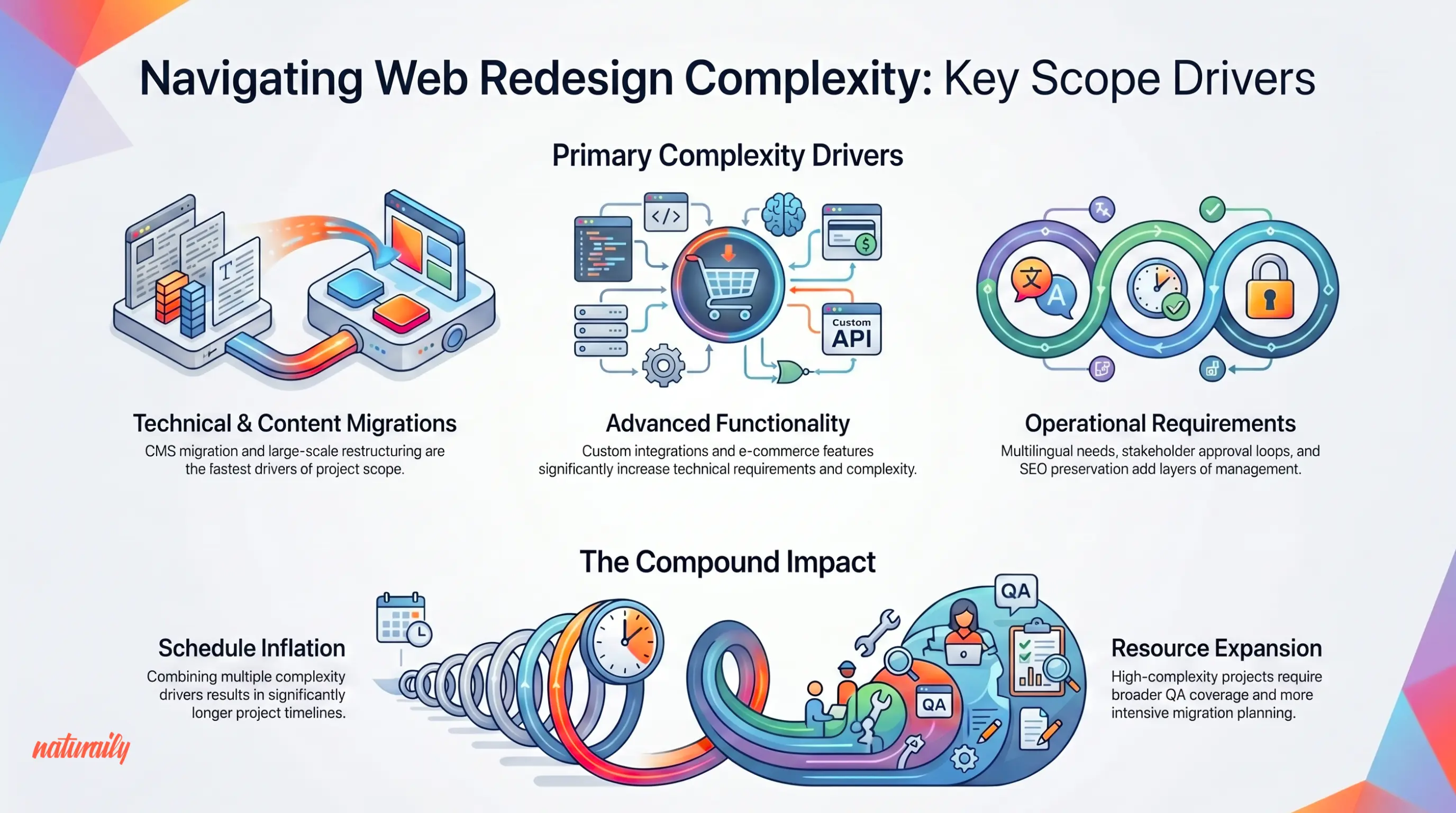
The largest cost increases come from dependencies discovered during implementation rather than from design work alone. CMS limitations, integration conflicts, content cleanup, and approval delays all compound over time once development starts.
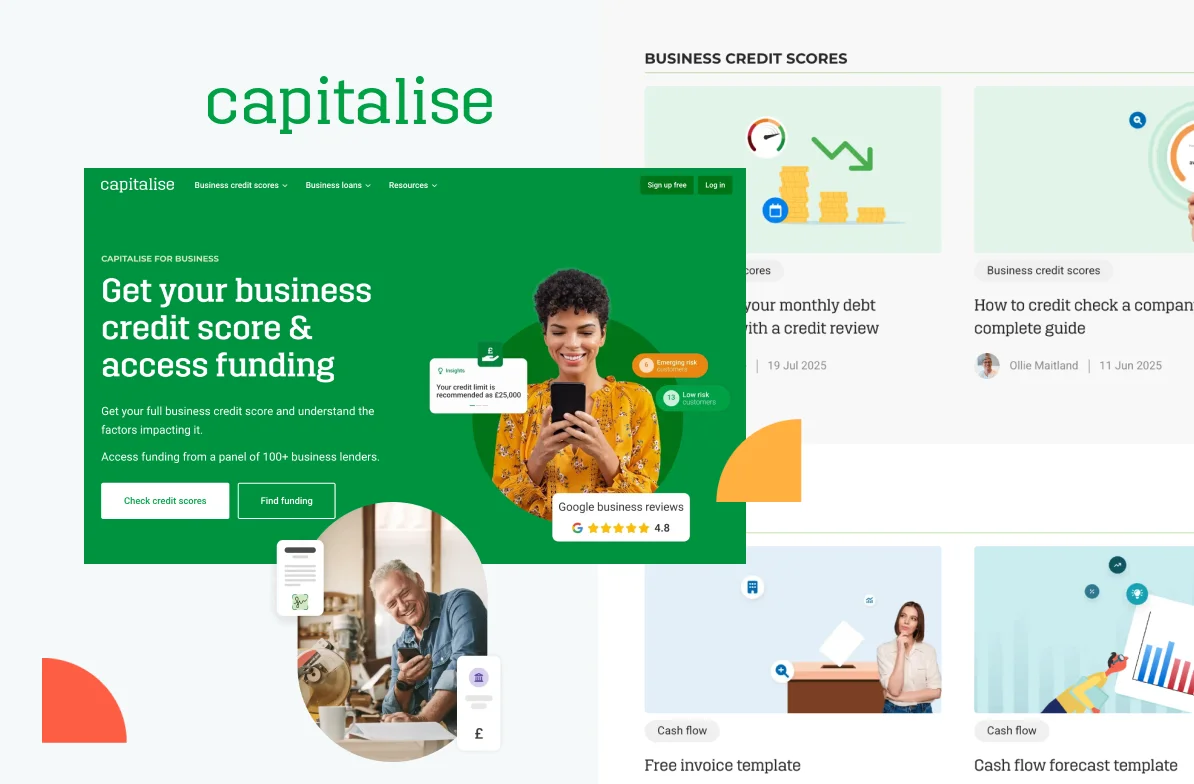
Capitalise
Business finance SaaS
Capitalise needed a modern website to replace their rigid legacy CMS and enable data-driven growth. We created a fast, headless platform with built-in A/B testing. Easy to experiment, optimize, and boost conversions.
48%
growth in average monthly traffic
31%
faster mobile LCP
35%
faster CMS content update
Why pricing ranges vary so much
Website redesign budgets are difficult to standardize because the visible website is only part of the project.
Two companies may both request “a redesign,” while one only needs updated templates and another requires:
CMS migration,
analytics reconstruction,
multilingual restructuring,
redirect mapping,
frontend modernization,
and integration rebuilding.
The websites may look similar after launch while the implementation effort behind them remains completely different.
Estimate by complexity and migration risk, not page count.
How long does a website redesign usually take?
A website redesign can take anywhere from several weeks to several months depending on the amount of structural, technical, and organizational change involved. Teams planning larger initiatives benefit from understanding broader website development budget and timeline expectations before defining redesign scope in detail.
Discovery and audit
The first phase focuses on understanding the current website.
Teams review the existing CMS setup, content structure, analytics configuration, integrations, SEO performance, and technical limitations before implementation begins. This stage reveals hidden dependencies that affect the rest of the project timeline.
In larger redesigns, the audit also becomes a prioritization exercise. Some problems need immediate resolution. Others can remain untouched to reduce unnecessary scope expansion.
UX, IA, and design
Design work starts with structure. Navigation changes, page hierarchy, content relationships, and user flows need validation early because they affect development, SEO, and migration planning later in the project. Once those decisions are stable, teams move into wireframes, component systems, responsive layouts, and visual refinement.
Feedback from multiple departments creates delays around messaging, navigation, and homepage structure, often before development has started.
Content and migration preparation
Content work often runs in parallel with design and development, which makes it one of the biggest sources of project dependency.
Pages may need rewriting, consolidation, localization updates, SEO cleanup, or complete restructuring before migration into the new system becomes possible. Late content decisions slow even simple redesigns, as they create dependencies across design, development, QA, and migration simultaneously.
Development and integration work
Once development starts, real content interacts with the new CMS, integrations, tracking, and frontend components simultaneously, which is when hidden problems surface."
Older systems often don't integrate cleanly with the new architecture, and existing content structures may not fit the updated template logic – problems that only emerge once development is underway.
Projects involving content restructuring, frontend flexibility, or multi-channel publishing often require broader architecture decisions during implementation. In those cases, working with a headless CMS agency can help teams avoid rebuilding the same limitations into the new platform.
QA and launch
Redirects, analytics tracking, responsive behavior, forms, metadata, integrations, accessibility, and performance all need validation before release. Technical SEO checks also become critical at this stage because structural mistakes can affect rankings immediately after launch.
Performance testing deserves particular attention. Research aggregated from Google, Deloitte, and Akamai data shows that 53% of users abandon websites taking longer than three seconds to load.
Launch preparation also includes deployment planning, monitoring configuration, rollback procedures, and post-launch observation windows.
Post-launch stabilization
A redesign project rarely ends the moment the new website goes live.
Teams still need to monitor organic visibility, analytics consistency, conversion behavior, CMS workflows, and user feedback during the first weeks after launch. Some issues only become visible once real traffic interacts with the new environment at scale.
Teams often use this phase to refine smaller UX issues, CMS workflows, or tracking inconsistencies discovered after launch.
Redesign projects usually slow down when
content decisions remain unresolved,
scope changes during implementation,
integrations are undocumented,
or multiple teams approve the same deliverables.
Most delays come from coordination problems rather than implementation speed alone.
Complex redesign projects need more than visual improvements
Talk to a team experienced in redesign strategy, migration planning, and technical implementation.
What makes redesigns more expensive than expected?
Content is rarely ready
Content delays are one of the most common reasons redesign timelines expand.
Pages still need rewriting while development is already underway. Teams discover outdated messaging, missing assets, duplicated content, or SEO gaps after migration planning has started.
Older websites require far more content cleanup than expected.
Stakeholder feedback slows everything down
Redesign projects involve competing priorities across marketing, leadership, sales, and product teams.
The issue is rarely feedback itself. Delays appear when decisions change repeatedly during implementation or when ownership remains unclear.
Integrations and SEO protection require additional work
Redirects, analytics tracking, metadata, search functionality, and third-party integrations all need validation during a redesign.
Most of this work remains invisible in the final interface, which is why teams often underestimate it during planning. Problems appear late in QA or shortly after launch.
When a redesign is really a replatforming project
Some redesigns expand once teams realize the current platform cannot support the workflows or scalability the new website requires.
The issue usually appears through workflow friction:
slow publishing workflows,
difficult localization,
inflexible templates,
fragile integrations,
developer dependency for routine updates.
Once those limitations start affecting implementation decisions, the project moves beyond visual redesign into broader platform changes.
At that stage, teams also start making longer-term architecture decisions around scalability, integrations, content workflows, and maintainability. Planning for those requirements earlier helps create a more future-proof website as the business grows.
Redesign vs replatforming comparison
| Focus | Redesign | Replatforming |
|---|---|---|
| Primary goal | UX and visual improvement | Platform and workflow modernization |
| CMS changes | Limited or none | Significant |
| Migration complexity | Moderate | High |
| SEO risk | Medium | Higher |
| Timeline impact | Lower | Higher |
| Long-term scalability | Depends on current CMS | Usually improved |
Before finalizing scope, it's also worth understanding which design directions are driving real business outcomes in 2026. See web design trends that improve leads, trust, and visibility for context on what's worth building toward.
FGS Global
PR agency
Naturaily modernized FGS Global’s website with a new stack that made content management easier, improved search functionality, and created a stronger foundation for growth.
5/5
Clutch review
Custom
search engine
1500+
content items migrated

How growing teams should budget for a redesign
The visible redesign is only part of the project cost. Content preparation, migration planning, technical audits, QA, SEO validation, analytics continuity, and post-launch support all influence the final budget.
Budget for planning and migration work, not only implementation
Discovery workshops, stakeholder alignment, content reviews, and launch preparation all require time across multiple teams.
On larger websites, those planning and coordination phases can affect delivery timelines as much as development itself.
Some costs appear after launch
Most redesign projects continue after release through performance optimization, analytics adjustments, CMS support, SEO monitoring, and smaller UX improvements.
That stabilization work should already exist in the budget during planning.
Leave room for uncertainty
Older websites rarely behave exactly as documented.
Content inconsistencies, tracking gaps, integration edge cases, and CMS limitations often appear during implementation. Smaller contingency buffers make those issues easier to absorb without forcing rushed scope decisions later in the project.
Hidden website redesign costs teams typically miss
Redesign budgets often expand around:
content migration – moving and reformatting legacy content usually takes longer than expected, especially with large archives or inconsistent structures,
redirect mapping – required to protect organic rankings and preserve existing traffic after URL changes,
analytics reconfiguration – tracking setups often break during redesigns and need rebuilding, testing, and validation,
CMS licensing – new platform tiers may be triggered by higher traffic, additional users, or expanded functionality,
localization updates – every language version requires separate content adjustments, QA, and publishing workflows,
accessibility remediation – redesigns frequently expose WCAG compliance gaps that require additional development work,
post-launch QA – issues often appear only after deployment across devices, browsers, and user paths,
stakeholder review cycles – additional feedback rounds commonly extend timelines and increase revision scope,
third-party integration adjustments – CRM, payment, marketing, or automation tools often require reconfiguration after structural changes.
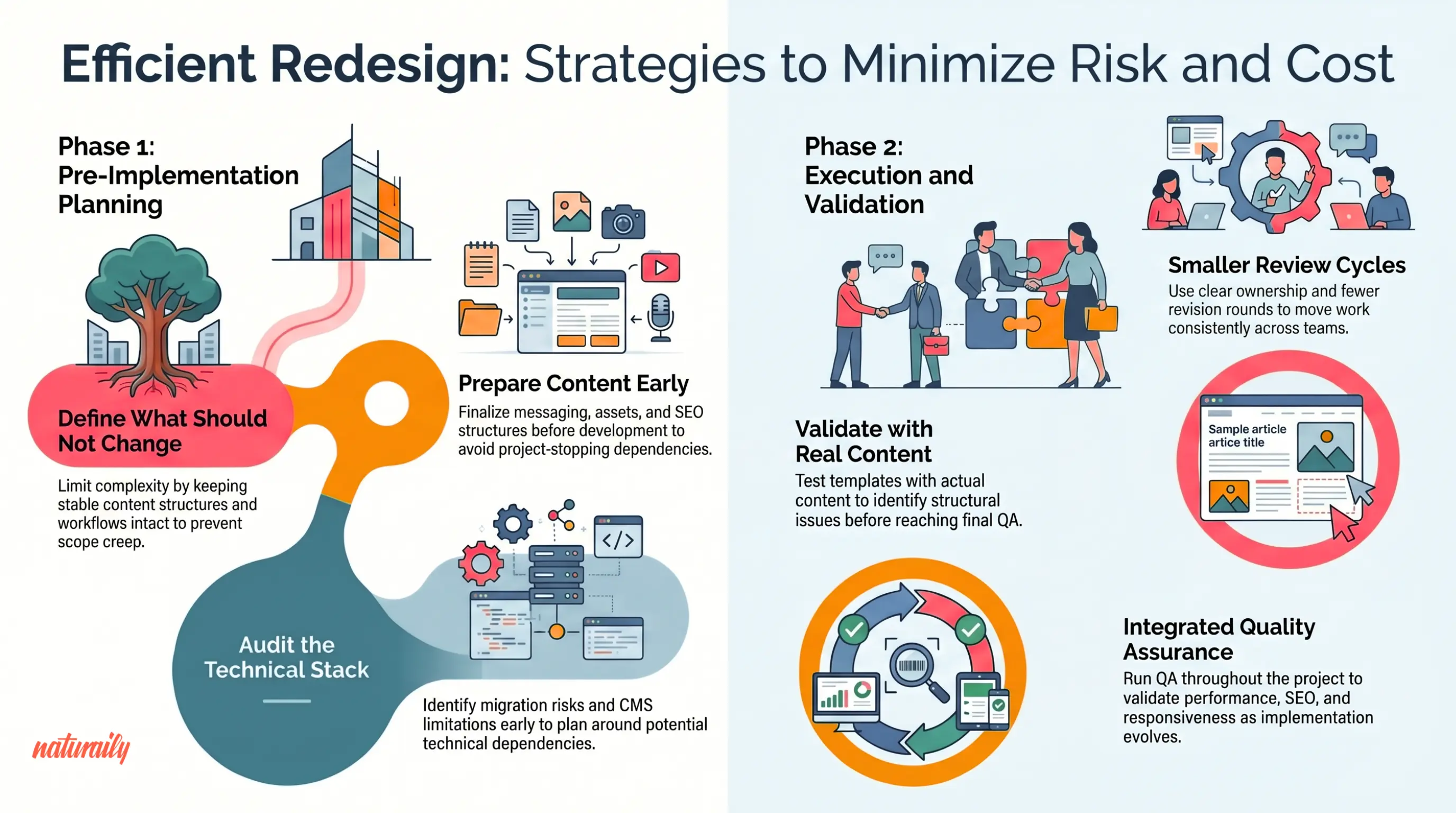
How to reduce redesign cost and timeline risk
Clear priorities, earlier validation, and tighter review processes reduce more risk than adding additional delivery time later in the project.
Decide what should not change
Not every part of the website needs redesigning. Keeping stable content structures, integrations, or workflows intact helps reduce unnecessary complexity and limits scope expansion during implementation.
Prepare content earlier
Unfinished content creates dependencies across design, development, QA, and migration work. Earlier content decisions reduce more delays than additional implementation time later in the project.
Keep review cycles smaller
Large approval loops create delays even on technically straightforward projects. Clear ownership and fewer revision rounds help redesign work move more consistently across design, development, and content teams.
Validate templates with real content
Placeholder copy hides structural problems. Real content reveals issues with layout behavior, localization, CMS workflows, and component flexibility much earlier in the process.
Audit the current stack before development begins
Technical audits help identify migration risks, fragile integrations, tracking gaps, and CMS limitations before they affect delivery timelines. The earlier those dependencies become visible, the easier they are to plan around.
Treat QA as part of the redesign process
QA should run throughout the project, not only before launch. Performance, SEO, analytics, responsive behavior, and integrations require repeated validation as implementation evolves.
Website redesign cost and timeline become easier to control once complexity is visible
Most redesign problems appear after implementation starts, when teams begin uncovering migration issues, platform limitations, or technical dependencies hidden inside the current website.
Earlier audits, clearer scope decisions, and tighter review processes make redesign projects significantly easier to plan realistically.
If you are preparing for a redesign and want to evaluate the technical scope before implementation begins, contact us to discuss your project.
FAQ
Redesign cost and timeline explained
Website redesign cost for growing companies typically falls into three broad ranges:
Light redesigns focused on UI updates and selective template improvements often start around $10,000-$15,000.
Mid-scope redesigns involving UX changes, CMS customization, SEO work, and content restructuring commonly range between $15,000-$30,000.
Complex redesigns with replatforming, integrations, frontend rebuilds, localization, or large-scale migration work frequently exceed $30,000-$75,000+.
The final cost depends less on page count and more on complexity, migration requirements, stakeholder involvement, and the condition of the existing platform.
A lighter redesign with limited UX and template changes may take 4-8 weeks. Mid-scope redesigns involving content restructuring, CMS customization, and SEO work often take 2-4 months. More complex projects involving replatforming, integrations, or large-scale migration work can extend beyond 6 months.
Timeline risk usually increases when:
content is not prepared early,
multiple stakeholders approve decisions,
integrations require restructuring,
or the redesign overlaps with CMS migration.
Most redesigns go over budget because teams underestimate existing complexity earlier in the project.
The most common causes are:
delayed content preparation,
changing stakeholder requirements,
underestimated migration work,
SEO remediation,
integration issues,
and CMS limitations discovered during development.
A redesign is usually cheaper when the current CMS, frontend architecture, and content structure can remain largely unchanged.
The cost difference becomes much smaller once teams start replacing integrations, restructuring content models, rebuilding templates, or modernizing the frontend stack. At that point, the implementation effort is a rebuild, regardless of what the project is called internally.
A redesign may require a CMS change when the current platform creates workflow or technical limitations.
Common signs include:
difficult content management,
poor localization support,
inflexible templates,
developer dependency for routine updates,
fragile integrations,
scalability issues.
If the CMS limits implementation decisions or long-term maintenance, replatforming may become necessary during the redesign process.
Post-launch costs often include:
CMS maintenance,
hosting and infrastructure,
analytics adjustments,
SEO monitoring,
performance optimization,
QA fixes,
incremental UX improvements,
and ongoing development support.
For larger websites, teams should also expect a stabilization period after launch while monitoring traffic, tracking accuracy, integrations, and CMS workflows under real usage conditions.
A redesign may not solve the underlying problem if:
publishing workflows are slowing teams down,
developers handle routine content updates,
integrations require constant maintenance,
or localization becomes difficult to scale.
At that stage, broader platform changes may deliver more value than visual improvements alone.
Larger redesign projects usually involve:
marketing,
product,
development,
SEO,
leadership,
and content teams.
The earlier those stakeholders align around priorities and scope, the easier the project becomes to manage.
Plan your website redesign with Naturaily
Work with experts in complex website redesigns, CMS migrations, and scalable frontend architecture.