How to Redesign a Website without Losing Rankings or Leads
What does redesigning a website without losing SEO mean? It means updating a site's design, structure, or CMS while preserving its existing URL architecture, keyword rankings, conversion paths, and technical signals, preventing traffic or lead drops during and after launch.


This matters more now than before. Organic search still drives a significant share of traffic, averaging 33% across industries, while 91% of organizations report SEO as a key growth channel.
At the same time, the margin for error is shrinking. Around 60% of Google searches now end without a click, and organic CTR continues to decline. Losing rankings during a redesign can be harder to recover from than before, especially when fewer searches result in organic clicks. A temporary technical issue can quickly become a long-term visibility and pipeline problem if it is not diagnosed early.
A redesign is one of the few moments when you can align your content, structure, and technical setup with both traditional SEO and AI-driven discovery. If this is not addressed during the process, the site may lose visibility not only in rankings but also in emerging AI interfaces.
AI-driven discovery includes AI Overviews, answer engines, conversational search, and LLM-generated recommendations that rely on clear structure, trustworthy content, and consistent entity signals.
This shift requires rethinking how content is structured, not just how it ranks. If you are planning beyond traditional SEO, see how to future-proof your website for AI search, accessibility, performance, and compliance.
Why website redesigns often cause traffic and lead loss
Why do rankings drop after a website redesign?
Search performance depends on consistency across multiple signals. Redesigns often disrupt those signals.
The most common cause of ranking loss is URL changes without redirect mapping. When URLs change without one-to-one 301 redirects, search engines treat the new pages as new content, losing the authority built on the originals.
This is where most redesigns fail. Teams move into design before aligning SEO, content, and migration planning. If you need a step-by-step framework, see the website redesign checklist.
This becomes more critical in the current search landscape. AI Overviews can reduce CTR for top-ranking pages by up to 58%, which means every ranking position carries more weight than before.
Leads drop when conversion paths break
Redesigns frequently introduce hidden conversion issues.
The most common conversion failures introduced by a redesign are form submission errors, which often occur silently, meaning no data reaches the CRM and no one notices until pipeline impact appears. CTA placement frequently weakens when templates change, reducing click-through on key pages. Thank-you pages that break after a form submission also corrupt attribution data, making it impossible to trace which campaigns drove leads.
Performance and UX changes affect outcomes
Performance and UX are primary drivers of conversion.
Page speed directly affects whether visitors convert. Websites loading in one second convert three times better than those loading in five seconds. Improving Core Web Vitals - Google's performance metrics for loading, interactivity, and visual stability - can increase both search visibility and on-page conversion rates, making performance a commercial priority, not just a technical one.
A redesign creates an opportunity to improve these factors, but only when performance is treated as a requirement.

Planning a redesign?
Get an SEO and conversion risk review before URLs, templates, tracking, or CMS decisions are finalized.
What to protect before changing anything
Protect high-value SEO pages
Focus on:
top organic landing pages
pages with backlinks
pages ranking for commercial queries
Only 1% of pages receive meaningful traffic, which makes these assets disproportionately valuable.
Protect high-value conversion pages
Identify:
product and service pages
pricing pages
demo and contact flows
These pages directly affect revenue.
Protect the current measurement setup
Audit:
GA4 events and conversions
form tracking
CRM integrations
attribution logic
SEO leads convert at 14.6% compared to 1.7% for outbound, which means any disruption to organic visibility or tracking accuracy has a direct and measurable impact on revenue.
Audit rankings, traffic, and lead paths before the redesign
Document current SEO performance
Capture:
keyword rankings
traffic by page
indexed pages
internal linking structure
Document current lead performance
Measure:
conversion rates
funnel progression
form submissions
Map the current user journeys
Understand:
entry points
navigation flows
conversion paths
This baseline defines what needs to be preserved.
It's also worth aligning on scope and budget before implementation begins. See website redesign cost and timeline to understand how audit findings typically affect project complexity and delivery.
Got the data but not sure what to do next?
Get support in turning insights into a safe, SEO-driven redesign.
Keep the parts that already work
Keep strong URLs where possible
URL stability preserves ranking signals and reduces reliance on redirects.
Keep search intent alignment
Maintain:
keyword targeting
heading hierarchy
content structure
Keep proven content sections
Sections that drive engagement or conversions should remain unless data supports change.
Keep internal linking to priority pages
Internal linking supports both crawlability and authority distribution. Rebuild it intentionally.
Redesign templates without weakening SEO or conversions
Validate templates with real content
Design decisions should be tested against existing high-performing pages to ensure compatibility.
Keep pages easy to scan and understand
Clarity and hierarchy determine how quickly users engage with content.
Design for mobile and Core Web Vitals
Only about 49.7% of mobile sites pass Core Web Vitals
Sites that pass CWV can gain additional visibility and improved engagement
This creates a competitive advantage during redesign.
For a broader view of which design decisions drive performance, trust, and visibility in 2026, see web design trends that improve leads and rankings.
FGS Global
PR agency
FGS Global needed a fast, flexible platform that could support a complex global structure without sacrificing speed, SEO, or editorial workflows. We delivered a headless Next.js solution that keeps performance high and content operations efficient at scale.
5/5
Clutch review
Custom
search engine for faster content discovery
1500+
content items migrated without disruption

Plan content, redirects, and internal linking early
Create a content inventory
Include:
traffic
rankings
conversion value
backlinks
Map every old URL to a destination
Use one-to-one redirects
Avoid redirect chains
Validate before launch
Redirect issues correlate strongly with other SEO problems. Sites with redirect errors are 72% more likely to have duplicate content issues.
Preserve internal linking
Rebuild navigation and contextual links to maintain authority flow.
Protect lead generation during the redesign
Audit all conversion points
List:
forms
CTAs
micro-conversions
Preserve tracking and attribution
Ensure:
events fire correctly
conversion paths are recorded
CRM receives complete data
Test lead flows end to end
Simulate real user behavior across all key paths.
DreamApply
EdTech
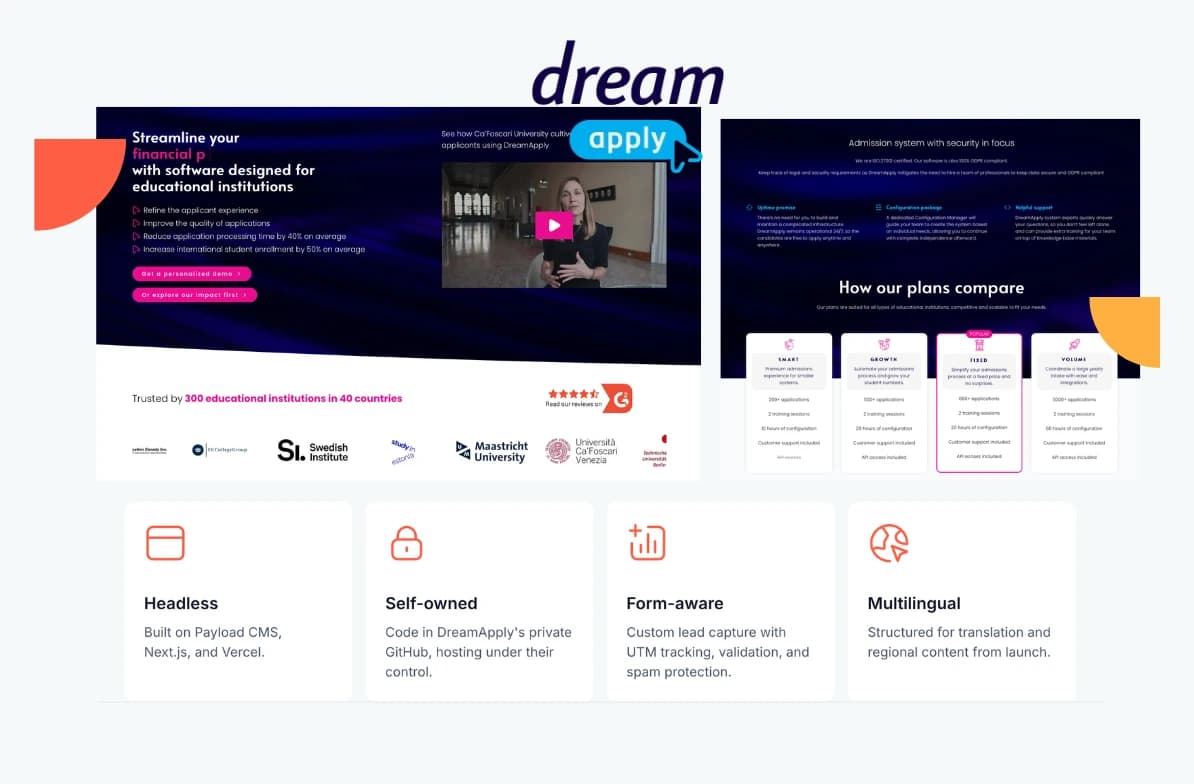
DreamApply moved its marketing site off WordPress to ease security and compliance friction, without weakening lead generation in the process. We rebuilt it as a headless site on Payload CMS, Next.js, and Vercel, and reworked the forms layer with UTM tracking, validation, and spam protection so submissions and attribution stayed intact through the transition.
Headless
rebuild on Payload CMS and Next.js
Form-aware
lead capture with UTM tracking and spam protection
Self-owned
code and hosting under client control
QA the redesigned site before launch
Use a structured migration approach with defined phases: preparation, testing, launch validation, and post-launch review.
SEO QA
Crawl staging
Validate redirects
Check metadata and canonicals
Confirm indexability
UX QA
Test navigation
Validate mobile usability
Review readability
Performance QA
Measure load speed
Optimize assets
Validate CWV
Analytics QA
Confirm tracking
Validate events
Check attribution
What to monitor after launch
Define expected behavior:
A traffic drop below 10% is typical and often recovers within weeks
A drop of 30-50% indicates a technical issue
Search engines may take up to six months to fully re-evaluate a redesigned site.
Monitor:
rankings
traffic by page
indexation
conversions
Timing also matters. Algorithm updates can amplify volatility. In August 2024, 44% of websites experienced ranking drops during a core Google update.
When a redesign is really a CMS or architecture problem
Some redesigns involve deeper structural changes:
CMS migration
URL restructuring
Multi-site consolidation
These increase complexity and risk. Migration frameworks classify them as medium SEO risk with high execution complexity. If your redesign involves a CMS change, planning the migration properly becomes critical for SEO and lead flow. Use this CMS migration checklist to avoid common pitfalls.
What it takes to redesign a website without losing traffic or leads
A website redesign requires controlled handling of SEO signals and conversion pathways.
Key priorities:
Protect high-value pages
Maintain SEO signals
Validate conversion flows
Test thoroughly before launch
Monitor performance after launch
In the current search environment, where CTR is declining and competition for visibility is increasing, preserving existing rankings is more valuable than incremental gains.
A well-executed redesign improves performance, strengthens conversion paths, and adapts the site to modern search behavior without sacrificing existing results.
Naturaily works across SEO, UX, and development to prevent that. If you are planning a redesign, reviewing your setup before launch can save months of recovery. We can help you with that. Let’s talk.
FAQ
Website redesign questions and answers
Protect URLs, redirects, content, and internal links during the redesign. Start by auditing high-value pages and keeping their URLs where possible. Map all necessary changes with one-to-one redirects, preserve search intent in headings and content, and validate technical SEO elements like canonicals, indexation, and internal linking before and after launch.
Yes, a redesign can reduce leads if conversion paths or tracking break. Lead loss typically comes from form errors, weaker CTA placement, broken attribution, or CRM issues. Even small UX changes can affect conversion rates, so all lead flows should be tested across devices and scenarios.
Yes, keeping URLs stable helps preserve rankings and traffic. Changing URLs introduces risk through redirects, which can fail or dilute SEO signals. If changes are required, use clean one-to-one redirects and avoid chains or loops.
Test SEO, UX, performance, and analytics before launch. Crawl the staging site, validate redirects and metadata, check navigation and mobile usability, measure load speed and Core Web Vitals, and confirm that tracking and conversions work correctly.
Rankings usually stabilize within weeks but can take up to six months. Short-term fluctuations are expected during re-indexing. Large or persistent drops often indicate technical issues such as missing redirects, indexing errors, or content changes.
No, a new CMS is only needed when the current one limits performance or scalability. A CMS migration increases complexity and SEO risk, so it should be driven by clear technical needs such as performance, flexibility, or content operations.
The biggest risk is losing rankings due to broken redirects or changed content. URL changes without proper mapping, removed pages, and weakened internal linking are the most common causes of traffic loss during redesigns.
Plan your website redesign with Naturaily
A successful redesign requires more than design execution. It requires alignment between strategy, UX, SEO, and technology from the start.