Web Design Trends in 2026: What Drives Leads, Trust, and Visibility
Web design in 2026 is about building websites that are easier to understand, faster to trust, easier to use, and to surface in both search engines and AI-generated answers.

The biggest shifts in web design are tied to business outcomes: how quickly people understand your offer, how easily they trust it, how smoothly they move through your site, and how clearly search engines and AI systems can interpret your content. The durable trends are the ones that reduce friction, improve findability, support performance, and make a brand feel distinct rather than generic.
The biggest web design trends in 2026 are these:
Component-first layouts such as bento sections and modular content blocks.
Brand-owned visual systems instead of generic template polish.
Color systems and expressive typography used with discipline, not decoration overload.
Platform-native motion using modern browser capabilities instead of heavy custom JavaScript.
Accessibility and performance treated as core design requirements.
Structured content written to work for people, search engines, and LLMs.
AI-assisted production workflows that speed up execution, but still require strong governance.
Selective human texture like tactility, imperfection, and craft to fight AI sameness.

Is your website ready for 2026?
Modern design is not just about looks. We help businesses improve clarity, performance, and conversion with websites built for people, search, and AI discovery.
Trend 1: Modular, component-first design is replacing one-off page design
One of the clearest developments in 2026 is the move toward modular, reusable page structures. Bento layouts, card-based sections, themeable design tokens, and structured content models are no longer niche ideas. They are becoming the default way smart teams build websites that can scale.
That is because they make websites easier to update, easier to localize, to personalize, and to keep consistent across campaigns, product pages, and landing pages.
For businesses, this is a serious advantage. A modular site is easier to test and improve. Marketing can launch faster. Product teams can stay aligned with the brand. Content teams can reuse high-value sections instead of reinventing pages from scratch. That kind of flexibility matters more in a market where websites are expected to evolve constantly, not once every two years.
How often a site needs rebuilding depends significantly on the architecture decisions made during the previous redesign. See website redesign cost and timeline to understand how CMS and component choices affect long-term scope and budget.
Trend 2: Visual design is moving away from template sameness
The visual mood of 2026 is clear: less interchangeable polish, more brand-owned character. The strongest visual direction right now is a reaction against AI-generated sameness. As more companies can produce decent-looking layouts quickly, the real differentiator is no longer having a clean website. It’s having a website that feels recognizably yours.
That is why visual trends are shifting toward fuller color systems, more expressive typography, selective texture, layered depth, glass-like translucency, editorial composition, and details that feel crafted rather than mass-produced. The most commercially sensible cluster, though, is not the most extreme one.
The safest high-return visual bets are stronger color systems, typographic expressiveness, and light tactile or glass effects that add polish without hurting readability or speed.
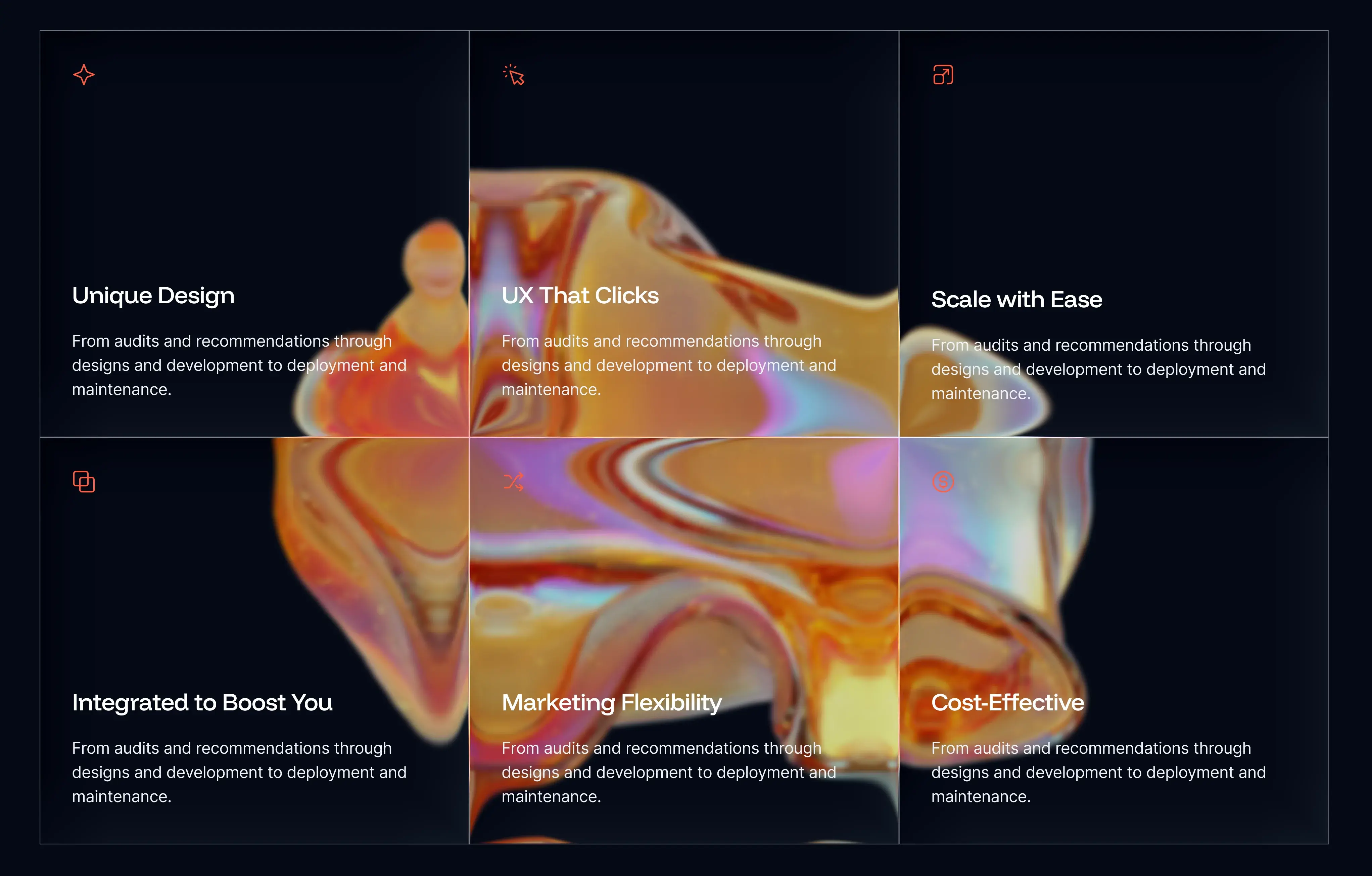
Glass effect example
This is an important point for business leaders: visual differentiation works best when it’s disciplined. A website doesn’t need to look wild to feel memorable. In most cases, one strong typographic system, one smart color strategy, and one controlled layer of depth or texture will do more for brand recall than a homepage full of effects.
Trend 3: Typography is doing much more of the selling
Typography has become one of the most effective design tools in 2026 because it helps brands look distinct without relying on asset-heavy visuals. Variable fonts, fluid type scales, stronger headline systems, and more editorial hierarchy are making websites feel more premium while still supporting performance, when used well.
That matters because type now does three jobs at once. It carries brand personality. It improves scanning. And it helps structure content for modern search and AI summaries. Good typography makes it easier for people to understand what matters first. Great typography makes that clarity feel intentional.
The practical lesson is straightforward. Use an expressive display type where it adds energy. Keep body text calm and highly readable. Test the smallest screen first, not the largest. Typography should increase confidence, not just add style.
Trend 4: Motion is becoming more native, lighter, and more useful
Another major shift is happening in interaction design. Teams are relying less on heavy custom JavaScript and more on platform-native motion and browser-level primitives. That includes view transitions, scroll-driven animations, popovers, and dialogs.
Interop 2026 is explicitly focused on improving several of these features across browsers, which is a strong signal that they are moving into the practical mainstream.
This matters because good motion improves comprehension. It helps people see what changed, what opened, what moved, and what action just happened. That kind of clarity makes interfaces feel smoother and more trustworthy. But the keyword is purposeful. Motion that delays reading, hides controls, or burns performance budget is not a modern experience. It’s just an expensive decoration.
Users should never have to wonder where something went or why a state changed. The best interactions answer that question instantly.
Turn trends into measurable growth
Not every trend deserves a place on your site. We help you choose the ones that support leads, trust, and long-term business goals.
Trend 5: Accessibility is now part of brand quality
Accessibility has moved far beyond the “best practice” category. It’s part of market access, procurement readiness, and overall digital quality. Focus visibility, target size, keyboard flow, motion preferences, forms, and readable content are no longer optional details. They are baseline expectations for serious digital products and services.
That direction is continuing. W3C published an updated WCAG 3.0 Working Draft in March 2026, which signals that accessibility standards are still evolving and still gaining strategic importance. WCAG 3.0 is not the live compliance standard today, but the update makes one thing obvious: accessibility is becoming more mature, not less relevant.
For business audiences, the message is simple. Accessibility is one of the clearest signs of good design. When a site is easier to navigate, easier to read, and easier to operate under real-world conditions, more people complete the journey.
Trend 6: Performance is now a design decision
In 2026, performance belongs in the design conversation from day one. The websites that win are not only visually modern. They are fast, stable, and responsive under real conditions. Core Web Vitals remain central to this discussion, especially as designers and content teams make choices about hero media, font loading, interactions, banners, and third-party tools.
When performance is weak, conversion suffers, trust drops, and every other investment on the page works harder for a worse result. The opportunity is still wide open, too. Industry data highlighted that only 43% of mobile sites achieved good Core Web Vitals under INP-based measurement in 2024, which means plenty of companies are still leaving easy gains on the table.
Performance gaps during a redesign are also one of the most common reasons sites lose rankings and leads post-launch. How to redesign a website without losing rankings or leads covers the specific risks and what to protect.
The bottom line is brutally simple: a beautiful slow website is still a bad website. In 2026, performance is part of the design brief.
Trend 7: Websites now need to be readable for humans and AI systems
One of the biggest strategic shifts in web design is not visual at all. It’s structural. Search is becoming more answer-driven, which means websites need clearer information architecture, stronger headings, better internal search, and content that is easy to extract, summarize, and trust.
That aligns with what is happening in AI-powered search. Semrush’s 2026 guidance describes AI search as a model that writes answers by pulling from multiple sources, and it frames the goal very clearly: brands now need to be referenced, cited, quoted, or mentioned inside synthesized responses, not just ranked on a classic results page.
This changes how good design works. It pushes teams toward scannable structures, question-led headings, semantic content blocks, clear proof near claims, and microcopy that makes decisions easier. In practice, that means content should not only look good on a page. It should also make sense when read out of context, pulled into a search summary, surfaced in a chatbot, or shown as a single snippet on a crowded screen.
For businesses, this is where an LLM-friendly structure becomes a revenue-friendly structure. A page that answers real questions clearly has a better chance of being found, trusted, and acted on.
Trend 8: AI is accelerating design workflows, but not replacing judgment
AI is now deeply embedded in how websites are designed and produced. Figma Make lets teams go from prompt to functional prototype, keep outputs aligned with a Figma library, edit generated results directly, and even connect real data into app-like experiences. Figma’s MCP server also brings structured design context into development workflows, so AI agents can generate code based on components, variables, layout data, and actual design logic rather than just screenshots.
Google Labs is moving in the same direction with Stitch, which now uses an AI-native canvas to create high-fidelity UI from natural language, lets teams add text, images, or code, supports voice-based critique, and exports into developer tools.
The practical takeaway is important. AI will absolutely speed up prototyping, drafting, iteration, and handoff. But it doesn’t remove the need for a strong system. It doesn’t replace positioning and doesn’t decide which proof belongs above the fold. It doesn’t know which friction point is killing your form completions.
The teams that benefit most from AI are the teams with the clearest rules, the strongest components, and the best taste.
What these trends mean for lead generation
All of this lands in one place: conversion.
A modular layout reduces content chaos.
Strong typography helps visitors find the point faster.
Better visual hierarchy makes proof easier to notice.
Accessibility removes hidden blockers.
Performance keeps people engaged.
Clear structure helps search and AI systems surface the right pages.
And distinctive visuals make the brand more memorable after the visit ends.
That’s why the smartest websites are easier to understand in the first 10 seconds. They answer real business questions faster. They make the next step obvious. And they avoid the all-too-common trap of hiding weak messaging behind visual polish.
What businesses should do before the next redesign
Before investing in another redesign, it is worth getting five things right.
Clean up the money pages. Make sure your homepage, service pages, and key landing pages answer the basics fast: what you do, who it is for, why trust you, and what to do next. Clear structure beats clever vagueness every time.
Build around reusable components, not one-off page layouts. That is what makes your site easier to improve over time instead of forcing expensive redesign cycles.
Choose one or two visual signatures and apply them consistently. Color, type, and a light layer of depth or tactility are usually enough. Most brands do not need five trends at once.
Treat performance and accessibility as creative constraints from the start, not QA tasks at the end. That is where quality gets built in rather than patched in.
Rewrite content for answer-first clarity. Search and AI discovery reward content that is structured, specific, and easy to trust.
If you're moving toward a redesign, the website redesign checklist covers how to apply these priorities across each phase – from audit to post-launch monitoring.
The best websites do more than look modern
The most important web design trend in 2026 is not one visual style, one animation pattern, or one AI tool. It’s the move toward websites that are clearer, faster, more distinctive, and easier for both people and machines to understand.
A website that meets that standard does more than look current. It earns attention, builds trust, supports search visibility, and creates better conditions for conversion. That is what modern web design is supposed to do.
If you need help turning these trends into a website that actually drives results, we can help you shape the right strategy, improve UX, and build a stronger digital experience. Talk to our team.
FAQ
Web Design Trends Explained
The biggest web design trends in 2026 are modular layouts, stronger visual identity, expressive typography, accessibility-first design, performance-driven UX, structured content, and AI-assisted workflows. The most durable trends are the ones that improve clarity, speed, findability, and trust, not just aesthetics.
Yes, but plain minimalism is no longer enough on its own. In 2026, many brands are moving away from generic, interchangeable interfaces and toward more ownable visual systems. That often means combining clean structure with stronger typography, richer color, subtle texture, or distinctive brand details.
The main visual trends include full color systems instead of one accent color, variable fonts and expressive typography, glass-like translucency, modern gradients, tactile textures, collage-inspired layering, and more human, less template-like design. The safest high-return choices for most brands are color systems, typographic expressiveness, and light tactile or glass effects.
Accessibility matters because it is now part of usability, compliance, procurement readiness, and overall digital quality. Modern websites are expected to support focus visibility, target sizes, keyboard navigation, reduced motion preferences, and clearer content. In practice, accessibility improves the experience for everyone, not just a small segment of users.
Performance affects design choices directly. Hero sections, typography, media, motion, scripts, and layout behavior all influence loading speed, responsiveness, and visual stability. In 2026, performance is not just an engineering issue. It is part of the design brief because slower websites create more friction and weaker conversion.
No. The best web design trends are the ones that match a company’s goals, audience, and buying journey. A B2B service company, an enterprise platform, and a portfolio site can all benefit from modern design, but they will not need the same degree of visual experimentation, motion, or AI features.
Planning a redesign? Start with what matters
Before you invest in a new website, make sure your structure, messaging, and UX are working hard enough to convert.