GEO vs SEO in 2026: What Growing Brands Actually Need to Change
Traditional SEO still drives discovery. At the same time, AI-generated answers are reshaping how users interact with search. This shift introduces a new layer of visibility, often referred to as AI visibility, where content is retrieved, summarized, and cited instead of only ranked.
The impact is already measurable. A Pew Research analysis shows that when AI summaries appear, users click traditional results in 8% of visits vs 15% without them. At the same time, research from Princeton and IIT Delhi shows that structured generative engine optimization (GEO) techniques can increase visibility in AI-generated responses by up to 40%.
To understand how to adapt, it is important to clarify the relationship between GEO vs SEO.
What is SEO in 2026?
SEO in 2026 still focuses on making content discoverable through search engines.
At the same time, generative engine optimization (GEO) expands this by optimizing how content performs when search systems generate answers. Instead of only ranking pages, content is evaluated based on whether it can be retrieved, understood, and cited.
GEO builds on technical SEO, content structure, and information architecture. The difference lies in how content is used after discovery, especially in the context of AI search SEO.
Planning a website rebuild for AI search?
Don’t lose visibility in AI answers. We design CMS architecture, content structure, and technical SEO so your site is ready for modern search.
GEO vs SEO: Key Differences in How Content Gets Discovered
SEO ensures discoverability. GEO strengthens AI visibility.
Both approaches rely on the same foundations. Crawlable pages, clear structure, and authoritative content still matter. The difference lies in how search systems present information and how success is measured.
Dimension
SEO
GEO
Primary goal
Rank pages and drive clicks
Become a cited source in AI-generated answers
Output format
Search results with links
Generated summaries and responses
Success signal
Traffic, rankings, conversions
Citations, AI visibility, mentions
Content format
Keyword-focused pages
Answer-ready, structured content
Technical focus
Crawlability, speed, linking
Technical SEO for AI search + extractability
Measurement
Clicks, impressions
Citations, presence in AI outputs
User journey
Search → click
Question → answer → optional click
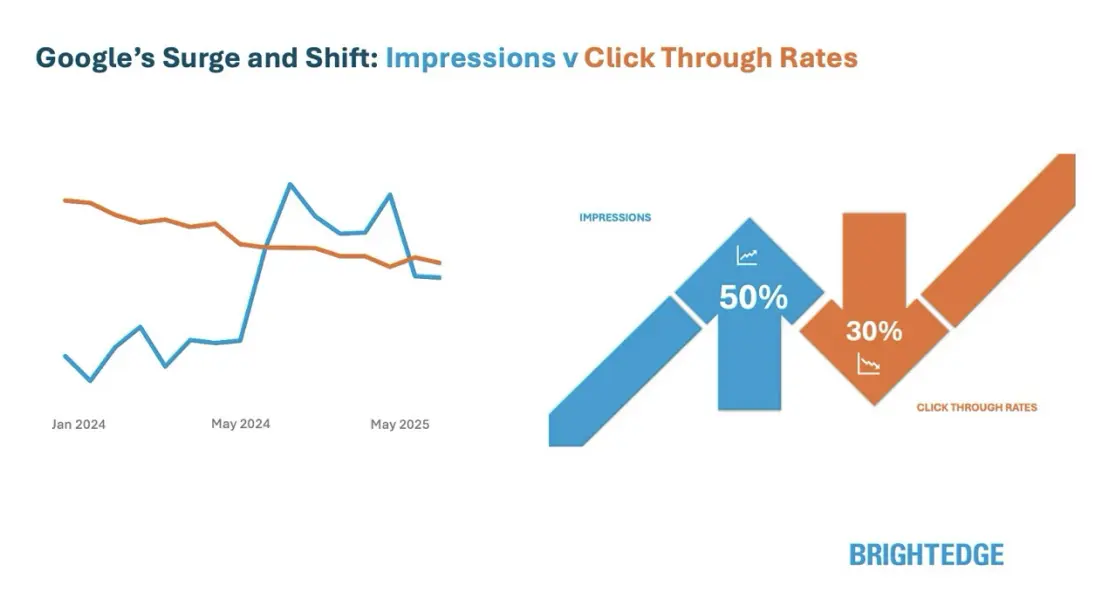
Recent industry research shows that search impressions increased by 49% while click-through rates dropped by about 30%, largely because AI summaries satisfy more queries directly on the results page.
Source: BrightEdge Report
SEO is still essential for discoverability, but GEO determines whether your expertise becomes part of the answers users see. The two disciplines work best together. Strong SEO ensures your content can be found. GEO helps ensure it can be used and cited by AI systems when answers are generated.
What Actually Changes for Brands in AI Search SEO
Content must support answer extraction
Content should be written so it can be easily reused in AI-generated responses.
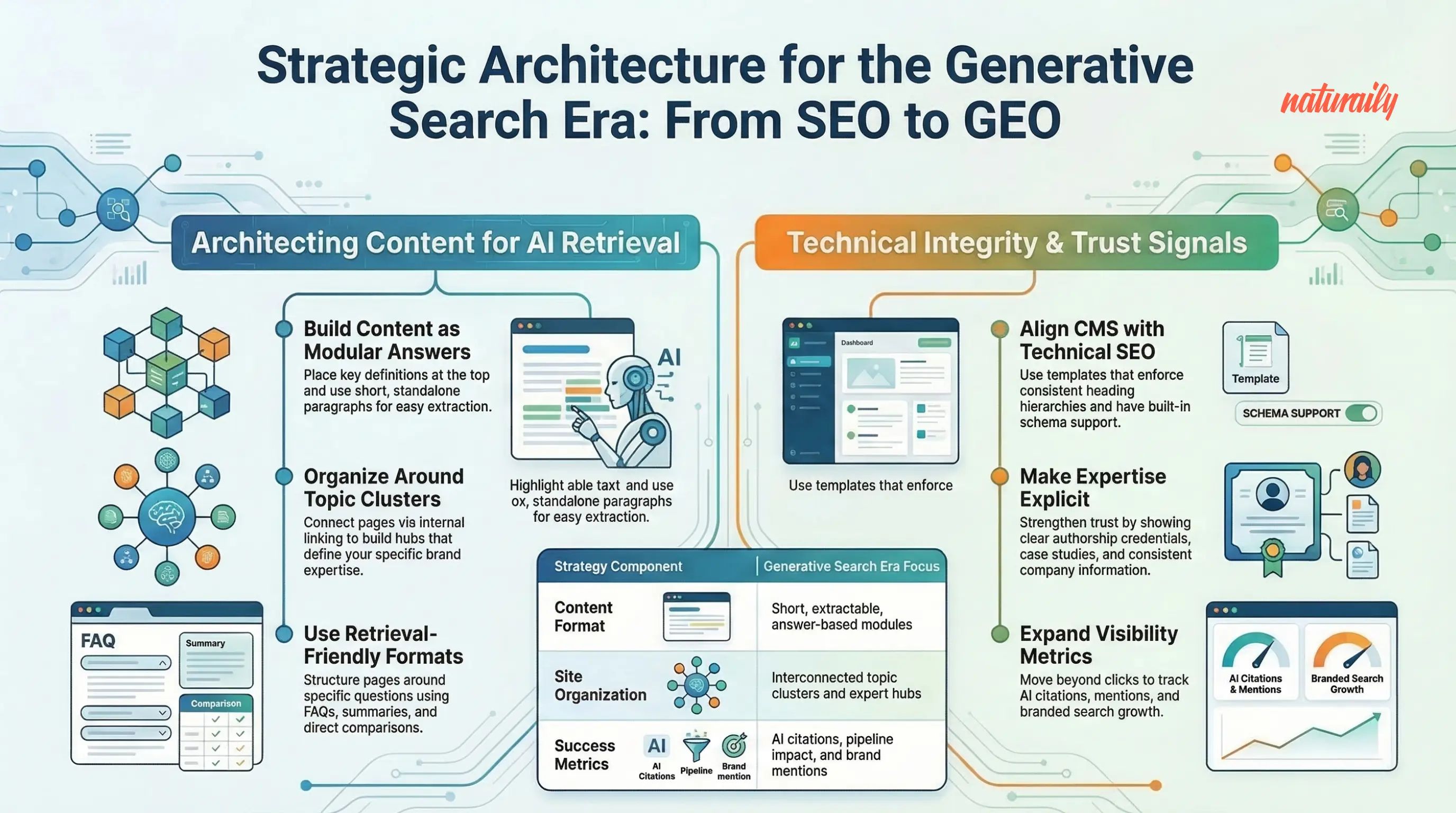
That means each page should focus on a clearly defined topic and answer a specific question. Place direct definitions and key explanations at the top of the page. Avoid long introductions that delay the answer.
Use formats that help extract information:
clear H2 and H3 headings that match real queries
short, answer-first paragraphs followed by detail
comparison tables, FAQs, summaries, and pros and cons
updated statistics with clear attribution
Research shows that structured content with verifiable data improves visibility in AI-generated responses.
For a deeper look at where AI systems pull those answers from on a page, and how query fan-out changes which pages even get considered, see our breakdown of the mechanics behind GEO vs SEO.
Content structure depends on the system you publish with.
Modern websites need CMS and templates that enforce structure by default. Reusable blocks for summaries, authorship, and FAQs improve consistency. Clean heading hierarchy and built-in schema support strengthen technical SEO for AI search.
A clean heading hierarchy ensures consistency across pages. Built-in schema support helps search systems interpret content correctly. Stable canonical URLs and indexation controls prevent duplication issues.
Strong templates also make internal linking easier, connecting related topics into a coherent structure.
Entity clarity matters more than keywords
Search systems increasingly rely on entity understanding rather than keyword matching. They evaluate who you are, what you offer, and whether your content fits a topic.
Clear signals about your organization, services, and expertise improve relevance and AI visibility. This includes:
strong About and service pages
visible authorship
consistent company data
topic clusters that define expertise
Your website needs to clearly communicate what your brand represents within a given topic.
Make your website ready for AI-driven discovery
From CMS to content structure, we build websites that search engines and AI systems can crawl, understand, and use.
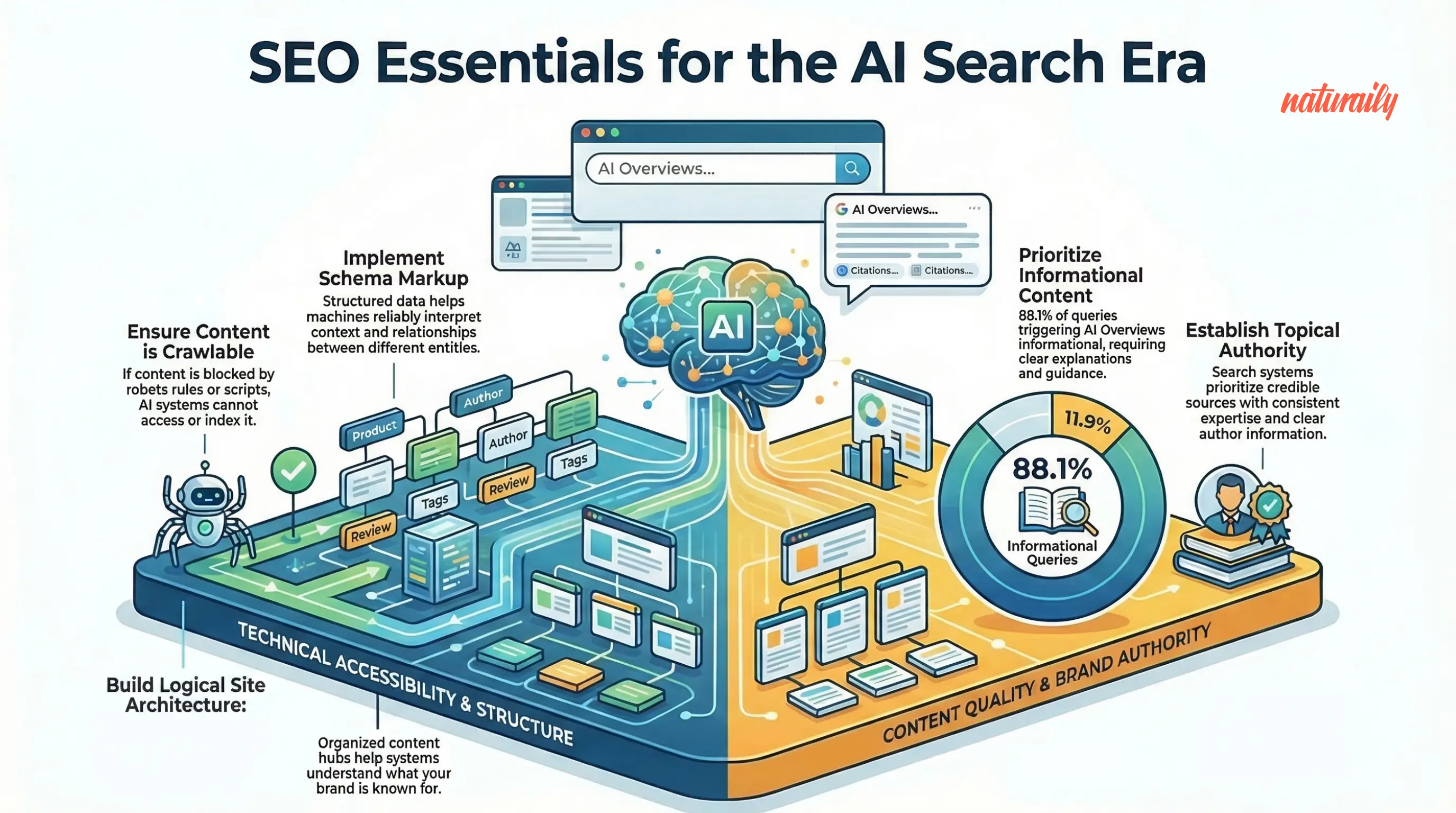
Technical SEO now affects whether your content can be used in AI-generated answers.
Key areas to focus on:
ensure important content is crawlable and not blocked
avoid rendering issues that prevent content from being parsed
use robots and snippet controls intentionally
maintain up-to-date sitemaps and fast update cycles
This is where technical SEO for AI search becomes critical.
How to Make Your Website Visible in AI Search
To improve AI visibility, focus on structural improvements:
ensure full crawl access
restructure key pages for answer clarity
organize content into topic clusters
implement structured data
strengthen authorship and trust signals
track visibility beyond traffic
1. Make sure your content is actually accessible
Verify that search engines can access your content. Check robots.txt, meta directives, and rendering. Make sure key pages are not blocked or dependent on heavy JavaScript.
If a system cannot crawl your content, it will not rank it or cite it.
2. Turn key pages into direct answers
AI systems look for answers. Your most important pages should:
explain what you do in the first few lines
define key concepts early
answer one clear question per section
Use summaries, FAQs, and comparisons. Remove long introductions that delay useful information.
3. Build topic-based architecture, not keyword pages
Group content into topic clusters supported by internal linking. Build category hubs that define your expertise and connect related articles, services, and case studies.
This helps search systems understand your authority and retrieve relevant content more effectively when generating answers.
4. Use structured data where it adds clarity
Implement schema where it adds clarity, such as:
organization
article
FAQ
product or service
While schema does not guarantee visibility in AI answers, it improves how your content is understood and connected to entities.
5. Show who is behind the content
Search systems evaluate credibility more rigorously than before, which means content is also judged by who stands behind it. That is why authorship and expertise need to be clearly visible.
Your About page, service pages, and case studies should clearly show what you do, who you help, and what experience supports your claims.
6. Stop measuring only traffic
Search data already shows a pattern: more impressions, fewer clicks as answers are delivered directly in search.
You need to track:
where your content is cited
how often your brand appears in AI tools
whether branded search is increasing
If you only measure clicks, you miss how search actually works today.
GEO vs SEO: Common Myths About AI Search SEO
Generative Engine Optimization has quickly accumulated misconceptions. Many of them lead teams to invest in the wrong areas or abandon strategies that still work. Clarifying these myths helps focus on what actually drives visibility.
“GEO replaces SEO”
SEO remains the foundation of discoverability. Search engines still need to crawl, index, and rank your content before it can be used in any context, including AI-generated answers. GEO builds on top of that foundation. Without solid technical SEO, content structure, and authority, there is nothing for AI systems to retrieve or cite.
“You need completely different content for AI search”
You don’t need a separate content strategy. What changes how the content is structured. Content that performs well in AI search is still:
accurate
useful
clearly written
The difference is that it is easier to extract answers from. Clear headings, direct explanations, and structured sections improve both SEO and GEO at the same time.
“Adding schema guarantees AI citations”
Schema improves how search systems understand your content, but it does not determine whether your content will be selected as a source. Relevance, clarity, and credibility still matter more.
“Publishing more AI-generated content is a GEO strategy”
Publishing large amounts of low-value or repetitive content reduces overall quality signals. AI systems prioritize reliable and original sources when generating answers.
Research shows that adding verifiable data and clear, structured information improves visibility, while tactics like keyword stuffing perform poorly in generative environments.
“Rankings no longer matter”
Search engines continue to use ranking systems to evaluate which content is relevant and trustworthy. Even when users do not click, rankings influence which sources are retrieved and used in AI-generated answers.
At the same time, rankings are no longer the only outcome that matters. Visibility now includes being cited, summarized, or referenced.
Find what blocks your visibility in AI search
We analyze your CMS, content structure, and technical SEO to identify gaps that limit your visibility in AI-driven search.
Measuring AI search SEO requires tracking two layers.
SEO metrics:
organic clicks to understand how much traffic search brings
impressions to measure how often your content appears
rankings to track visibility across target queries
non-brand traffic to evaluate new audience acquisition
assisted conversions to see how SEO contributes to the pipeline
GEO metrics:
AI citations: whether your content appears as a source in AI-generated answers
cited URLs: which pages are referenced most often
grounding queries: the types of prompts and questions where your content is used
branded search lift: increases in searches for your company or product
direct traffic from AI tools, where it can be tracked
assisted pipeline, where AI-driven discovery contributes to conversions
GEO vs SEO: What Should Brands Do in 2026?
To succeed in AI search SEO, websites need to function as structured systems.
build content that answers specific questions
align content, CMS, and technical SEO
organize around topics instead of keywords
make expertise explicit and verifiable
remove friction in content access
measure visibility beyond clicks
Consistency across these areas determines performance.
What Drives AI Visibility Today
Search visibility no longer depends only on rankings. Content needs to be structured, accessible, and clear enough to be used in AI-generated answers. Brands that align content, CMS, and technical SEO gain visibility across both traditional search and AI systems.
If your website was not designed for this, it will limit your growth. Naturaily helps teams audit and build websites with strong technical SEO for AI search, ensuring your content can be found, understood, and used. Contact us to make your website ready for modern search.
FAQ
AI Visibility Explained
01
What does generative engine optimization actually mean?
Generative engine optimization (GEO) is the practice of making content easier for AI-powered search systems to retrieve, understand, and cite. It focuses on structuring content so it can be used in generated answers, not just ranked in search results.
02
Is GEO replacing SEO in 2026?
No. SEO remains the foundation of search visibility. GEO builds on SEO by optimizing how content is used in AI-generated answers. Without strong technical SEO and content structure, there is nothing for AI systems to retrieve or cite.
03
How does AI search change the way brands get found online?
AI search changes discovery by delivering direct answers instead of only listing links. This means users often get information without visiting a website. As a result, visibility depends not only on rankings, but also on whether your content is selected and cited in AI-generated responses.
04
Do brands need a separate GEO strategy, or just better SEO?
Most brands do not need a separate strategy. They need to improve how their existing SEO works by making content clearer, more structured, and easier to extract. GEO is an extension of SEO, not a replacement.
05
What content performs better in AI search results?
Content that is clear, structured, and focused on answering specific questions performs best.
This includes: concise explanations near the top
well-defined sections, comparison tables and FAQs, verified data and attributed claims. Content that is easy to extract and reuse is more likely to be cited.
Generative engine optimization (GEO) is the practice of making content easier for AI-powered search systems to retrieve, understand, and cite. It focuses on structuring content so it can be used in generated answers, not just ranked in search results.
Content design is the practice of deciding what content a user needs at each step and shaping it to meet that need. It starts from the user's problem and the evidence, then chooses the clearest format, whether that is a sentence, a list, a table, or a diagram. UX writing is one part of it.
Microcopy is the small, functional text in a digital product: button labels, form hints, error messages, empty states, and confirmations. A good microcopy tells a user what just happened and what to do next, in as few words as possible, so they can finish the task without stopping to think.
UX writing is the practice of writing the words inside a digital product: buttons, menus, form labels, error messages, and empty states. Good UX writing helps someone finish a task without confusion or a support ticket, and it ships as part of the interface rather than a document added later.