
— AI AGENT DEVELOPMENT · CONTENT AUTOMATION
Custom AI content agents for your CMS
Bulk edits across thousands of pages. Content audits that used to take a quarter. Translations that respect your glossary. Migrations nobody wanted to start. Our agents do the work inside your CMS, and your team reviews every change before it goes live.
No CMS migration required. We build on Storyblok, Strapi, Payload, Sanity, and the platform you already run.
0%
of agent work is operating on existing content, not writing new copy
AI Content Operations Report
0 wks ~
from first read-only audit to agents running in production
across 12,500 organizations
0
changes published without human approval
our architecture, every project
— THE BOTTLENECK
Content operations don't scale by hiring
Your CMS holds years of content, and every change routes through the two or three people who know how it's wired. So the backlog looks like this:
A price changed once in the PIM and is now stale on five pages.
"Bulk update" means a spreadsheet, an export, and someone's weekend.
The translation backlog grows faster than the localization budget.
Legal needs every regulated page checked against the new wording. Someone opens them one by one.
The migration off the legacy CMS has been "next quarter" for six quarters.
AI writing tools don't touch any of this. Writing was never the bottleneck, but operating the content is.
What is a content agent?
A content agent is an AI agent connected to your CMS that executes content operations: auditing, editing, publishing, migrating, and translating content at scale. It understands your content model, works through governed APIs with scoped permissions, and stages every change for human review before anything publishes.
You'll also hear this called an agentic content pipeline, content automation, or an AI content workflow. Same thing: the pipeline is the governed structure, the agents are the workers inside it.
| AI writing assistant | Content agent | |
|---|---|---|
| Knows your CMS schema | No | Yes: fields, validation, references |
| Works on | New text in a chat window | Existing content across your repository |
| Scale | One document at a time | Hundreds or thousands per operation |
| Output | Copy you paste into the CMS | Staged drafts with field-level diffs |
| Governance | None | API permissions, audit trail, rollback |
tsx
— CONTENT AUTOMATION
Content automation your team can trust
Content automation means software doing the content work your team now does by hand - updating, tagging, translating, auditing, and migrating content. AI content agents are how it's done today: they read your schema, act through governed APIs, and stage every change for a person to approve.
Most tools bolt automation onto your CMS and hope. We build it into a governed pipeline, so scaling the work never costs you the approval step.
Wondering if your content is ready to automate?
— USE CASES
Each maps to a proven agent mode and to how your team already phrases the work.
Five things content agents do in your CMS
Bulk editor
Built for visibility, not black boxes
Updates run across your whole repository, validated against your schema and staged as drafts for review, not fired off blind.
> Replace acmecorp.com with acme.io everywhere, and show me the diff.
Auditor
Find what nobody has time to check
Missing meta descriptions, stale pages, terminology drift, broken references, compliance mismatches. For example, an agent can catch promotion dates in the copy that didn't match the campaign's real start and end dates.
> Find every product page missing alt text and draft it.
Migrator
Move legacy content into structure
Out of WordPress, Webflow, or Word documents into your content model, with metadata, images, and references intact. This is where quarters of work compress into days.
> Map these 4,000 legacy articles to the new content model.
Translator
Localize every market to glossary
Translates across all your locales when source content updates, following your terminology glossary and preserving references. Editors review locale nuances before publish.
> Translate the updated pricing pages into all 12 locales, glossary applied.
Researcher
Bridge your content and the web
Competitor coverage, trending topics, and gaps in your own library. A newsroom editor called it "the kind of work I used to do manually every day."
> What's moving in our space that we haven't covered yet?
Where the ROI actually lands
Routine queries and edits are 91% of agent volume and keep operations running daily. The other 9% - migrations and localization pipelines - is where the dramatic return lives.
— GOVERNANCE
How agents change content without breaking it
One rule governs everything we build: guarantees live in the system, never in the prompt. The CMS backend stays deterministic and holds truth and control. Agents live in a separate layer and only handle judgment - interpreting intent, drafting, recommending.
Scoped permissions at the API
Each agent gets least-privilege access enforced by the backend, not by prompt instructions. "May read products, draft price changes, publish nothing" is a permission scope, not a hope.
Every change staged, nothing auto-published
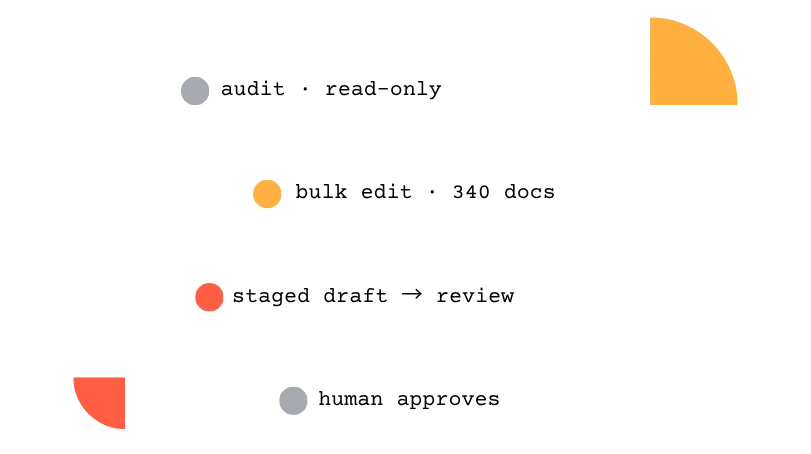
Agent output lands as drafts in your existing approval workflow. Releases ship atomically and roll back cleanly.
Field-level diffs for reviewers
Your team sees "price went 90 → 190 on 340 documents," never "a file changed." Reviewable diffs are what make delegation safe at scale.
Schema validation on every write
Required fields enforced, references intact, types matching. The agent physically cannot save content that violates your model.
Why not just embed everything and skip the structured CMS?
You may have read the argument that LLMs make structured content obsolete: chunk it, embed it, retrieve by similarity. It fails on operational questions. "Every product over $100, in stock, not yet translated to German" is a database query; vector similarity can't guarantee that filter. And agent success rates drop from roughly 70% on isolated tasks to about 25% when one change spans many files. References and structure design that problem out. Structure didn't become obsolete - tagging it became cheap, because agents now do it.
— WHY NATURAILY
Built-in agents are generic. Yours won't be.
Some platforms now ship a built-in content agent. Most don't - Contentful, Storyblok, Strapi, Payload, Umbraco, WordPress, and every legacy platform leave you with autocomplete at best. And even the built-in ones don't know your terminology, your compliance gates, or the PIM feeding your product pages. We build the agent layer that does.
01
Agent-enable the CMS you already have
MCP servers, agent APIs, schema context, and permission scopes on top of your current platform, so agents from Claude, ChatGPT, or your own stack can operate it safely. No forced migration. If one is genuinely the right call, we'll say so and build the agent that runs it.
02
Custom agents for the operations that pay off
Purpose-built for the proven high-ROI cases: legacy migrations, translation pipelines with glossaries, SEO and metadata backfills, regulated-page audits, and product-content sync with your PIM or ERP.
03
The engineering-content bridge
Agent projects stall for organizational reasons: no AI policy, messy architecture, and no one who speaks both engineering and content. Top teams run ~90× more agent activity than the median with identical tools. That bridge role is exactly what we do.
Naturaily has built on headless CMS platforms for years, and our AI agent development services grow directly out of that practice. We know component systems, schema constraints, and API patterns, and we've seen how content models rot: unmaintained component libraries, inconsistent naming, undocumented constraints. That's why the schema audit is the first deliverable of every project. You can't build a reliable agent on an unreliable content model, so we fix the model first.
— HOW WE WORK
From read-only to production in about eight weeks
Industry data across 12,500 organizations shows prepared teams reach production agents in roughly eight weeks. The model can draft on day one; the eight weeks build your team's trust, one scope expansion at a time.

WEEKS 0-1
Content-readiness audit
We map your schema, content health, and workflows, and tell you honestly whether your content is agent-ready and what to fix if it isn't.
WEEKS 1-3
Read-only agents
Audit and analysis agents that query and report but change nothing. Your team learns exactly what agents see.
WEEKS 3-6
Drafting with review
Agents propose changes as staged drafts with field-level diffs. Humans approve every single one.
WEEKS 6-8
Production operations
Recurring, scheduled workflows - audits, syncs, translations, backfills - with a named operator and instrumented cost per operation.
We share progress and viability at each stage. If it isn't working, you find out at week 3, having spent discovery hours, not the full build.

Polina Medvedieva
SEO Manager at n8n
High skills and responsibility make them a reliable, trustworthy, and professional technological partner. They grasp even the most nuanced details of our requirements and are effective in managing project needs.

Kyle Yeager
Digital Director at Beuta
Naturaily impressed us with their approach to user-centric design and practical e-commerce solutions. They improved our website's UX, making it look good and work well for bulk purchases.

Charlie Rodman
Director at Nerdy Banana
A team that’s proactive, collaborative, and great at communicating. They've become a partner in the true sense.

Elsa Favario
Marketing Director at Urban
I would highly recommend Naturaily for their commitment to delivering a good product. They demonstrated a strong ability to push for answers that allowed us to fine-tune the CMS to meet our specific needs.

David Campbell
Managing Director at FGS Global
A team of high-caliber talent & modern tech expert knowledge. With their help, any website project is much easier, better, and faster.

Ardit Veliu
Marketing Director at Expert Institute
Naturaily shines with its skillful development team which can build outstanding websites. They present a huge dedication to making web development with quality in mind.
— TWO AUDIENCES, ONE PIPELINE
What this means for your team
For marketing & content leaders
Anyone can publish. Provide a source document and page type. Get a draft back with structure, fields mapped, alt text and SEO metadata filled.
Migrations become projects, not eras. Legacy content moves in weeks with your team reviewing batches, not retyping pages.
Every market, every locale. Content localizes automatically when source updates. Editors review nuance before publish.
Audits on demand. Stale pages and missing fields surfaced in a structured report, not something you hunt for once a quarter.
You stay in control. Every agent output routes to a reviewer. Nothing ships without your approval.
For technical leaders
Least-privilege access. Each agent touches only what it's authorized to. The Asset Agent can't modify content fields; the Writer Agent can't reach the media library.
Schema-aware by design. Agents can't produce content that violates your schema. The registry is built first; agents reason against it, not around it.
Full pipeline visibility. Every step is an inspectable node. Inputs, outputs, and failure states are auditable. No black boxes.
Agents draft, humans publish. Enforced at the API, so no prompt and no bug can skip your approval step.
Measurable cost per operation. Token usage, latency, and cost captured per agent per run from day one.
— TECHNOLOGY
The stack we build on
We choose tools with strong headless CMS ecosystems, active communities, and transparent extensibility. No proprietary lock-in. No surprise pricing.
Headless CMS
Strapi · Sanity · Payload · Storyblok · Contentful
Agent protocols
MCP servers · agent APIs · schema context
Workflow automation
Orchestration, retries & flow control
Translation layer
Specialized services + LLM context
LLM APIs
Your keys. Your model choice.
Content sources
Google Drive · Notion · Direct upload

Start with a free content-readiness audit
Tell us your CMS, your content volume, and where the friction is. We'll assess whether your content model is agent-ready, show you which of the five operations would pay off first, and tell you honestly if agents aren't the right fix yet.
— FAQ
Common questions about content agents
A content agent is an AI agent connected to a CMS that executes content operations such as auditing, bulk editing, translating, and migrating content, while humans review and approve every change. Unlike a writing assistant, it understands the content model and works through governed APIs with scoped permissions.
A writing assistant generates text - you still open the CMS, build the page, and paste content field by field. A content agent operates the CMS itself: it reads the schema, edits or creates documents at scale, and stages everything as reviewable drafts. Industry telemetry shows 91% of real agent activity is operations on existing content, not new writing.
No. We build the agent layer - MCP servers, agent APIs, schema context, and permission scopes - on top of the CMS you already run: Contentful, Storyblok, Strapi, Payload, Sanity, Umbraco, and others. If your platform genuinely can't support governed agent access, we'll tell you and scope the migration as an agent-driven project.
Built-in agents are generic. They don't know your terminology, your compliance rules, your approval chains, or the PIM and ERP systems your content depends on. Custom agents encode those specifics, and on most platforms there's no built-in agent at all, only writing-assist features.
Not in anything we build. Every agent output lands as a staged draft with field-level diffs, routed through your approval workflow. Permissions are enforced at the API level, so an agent scoped to draft-only cannot publish regardless of what a prompt says.
Bulk edits and audits show value in the first week because they replace spreadsheet-driven manual work immediately. The largest returns come from the long tail: legacy migrations, localization pipelines with terminology glossaries, and SEO metadata backfills, where agents compress quarters of work into days.
They describe the same system from two angles. The content pipeline (you'll also see "agentic content pipeline") is the governed structure: schema context, permission scopes, staged review, delivery. The content agents are the workers inside it: auditor, bulk editor, migrator, translator, researcher. When someone says "content automation," this combination is what they mean.
Content automation means software executing content work that people currently do by hand: updating, tagging, translating, migrating, and auditing content. AI content agents are how it's done today. They understand your content model, act through governed APIs, and stage every change for human approval, so automation scales without losing control.