What Does Custom Web Development Mean At Naturaily?
Most websites look unique on the surface, but under the hood they run on the same templates, plugins and limits, and at some point, that sameness starts to cost you money. That’s usually when people say, “Maybe we need something custom.”

But what does custom web development actually mean at Naturaily? Is it just “no templates”… or is it a different way of thinking about your whole digital setup - from content and commerce to AI and future growth?
What “Custom Web Development” Means Today (And Specifically at Naturaily)
Key points
It’s no longer “we coded it from scratch,” but strategic architecture.
It’s not the opposite of a CMS; it often uses headless CMSs and platforms, but on your terms.
The goal is to engineer a digital product that fits your business like a tailored suit, not squeeze you into a theme.
Today “custom web development” is very different from what it was ten years ago.
The modern definition, especially in Naturaily’s work, is:
Custom web development is designing and engineering a bespoke digital system (website, app, or platform) around your exact business model, content, data and growth plans, instead of bending your business to fit a pre-made template or all-in-one suite.
Crucially:
It’s not defined by the absence of a CMS.
It is defined by owning the architecture: what tools are used, how they connect, what’s custom, what’s off-the-shelf, and how easy it is to change things later.
At Naturaily, a “custom web development” project typically includes:
A modern frontend (usually Next.js / React + TypeScript) for speed and flexibility.
A headless CMS (Storyblok, Sanity, Contentful, etc.) so your marketing/content teams work independently of developers.
Composable backend services - e-commerce (often Shopify or another engine), search (e.g. Algolia), analytics, identity, payments and more.
Glue code, design systems and workflows that are unique to your organization, not copied from a theme.
Think of it as the difference between:
Renting a generic office in a shared building (template / monolith) vs
Designing your own HQ with the exact rooms, flows and infrastructure you need (custom architecture).

Not sure if you really need custom?
Share where you are now and we’ll tell you honestly whether a custom build makes sense or a simpler option is enough.
Why Businesses Move From Templates to Custom - The Triggers We See
Most clients don’t start with custom - they grow into it.
Triggers are usually bottlenecks, revenue leaks, or risk.
Templates work… until the combination of growth + complexity breaks them.
Around 72% of businesses now say they prefer custom solutions over off-the-shelf websites, precisely because they hit limitations with generic tools as they grow.
In Naturaily’s pipeline, companies usually come to custom web development when at least one of these is true:
1. Growth has outgrown the template
The website can’t cope with traffic spikes, complex funnels, multi-country rollouts or multiple brands.
Performance becomes fragile: plugin conflicts, caching hacks, crashes during campaigns.
2. Marketing is stuck waiting on developers
Every landing page, campaign, or experiment must go through engineering.
Simple changes take weeks, killing speed and experimentation.
3. Security and compliance worries
Heavy reliance on third-party plugins creates a broad attack surface.
Open-source CMSs attract automated attacks; one bad plugin can expose the whole system.
The average cost of a data breach reached about $4.88M globally in 2024, and over $10M in the U.S., so the risk is no longer theoretical.
4. You need something that simply doesn’t exist in a theme
Complex product builders, bespoke quoting flows, headless commerce, deep integrations with ERP/ATS/CRM, or sophisticated search and filtering.
You want to own the UX and not be limited by what a theme author imagined.
5. You’re thinking beyond “website”
The same content and product data must serve web, mobile, in-store screens, partner portals, chatbots and AI agents.
That requires API-first, “headless” and MACH-style architecture - which is, by definition, custom.
When several of these collide, staying on a template platform becomes more expensive - in lost revenue, staff time and risk - than making a deliberate move into a custom stack.
Custom vs Template: A Business-Level Comparison
Templates are great for small, early-stage or low-stakes sites.
Custom shines when you care about performance, differentiation, complex flows and long-term ROI.
The real question stops being “WordPress vs custom?” and becomes “Where do we need control vs convenience?”
From the Naturaily perspective, the practical distinctions look like this:
Templates / standard platforms
Best when you:
Need to launch fast and cheap.
Have simple, brochure-style content and basic forms.
Don’t need much integration beyond a standard shop and a few scripts.
Are testing an idea and don’t yet know if it will stick.
Risks:
Limited differentiation - your site looks and feels like many others.
Stacked plugins means performance bloat and fragility.
Hard to implement non-standard flows or custom data models.
Hidden long-term costs (premium plugins, rebuilds, replatforming).
Custom web development
Best when you:
Treat the website as a core channel or product, not a brochure.
Need unique UX, flows, and integrations that aren’t available off-the-shelf.
Require high performance, accessibility and Core Web Vitals discipline.
Have multi-market, multi-brand or multi-channel ambitions.
Benefits include:
Uniqueness & branding - every component reinforces your brand, not a generic template.
Feature freedom - you can integrate anything: custom booking, complex product configuration, internal tools, AI/LLM workflows.
Performance by design - no plugin baggage, lean code and modern hosting make it much easier to hit Core Web Vitals.
Long-term ROI - you invest once into an asset that can evolve instead of throwing money at patches and rebuilds every few years.
In short: templates minimize upfront cost; custom minimises long-term friction. For serious, growing businesses, the total cost of ownership often tilts in favour of a well-designed custom setup over 3-5 years.
The Business Value: What You Actually Gain From Custom Web Development
The value shows up in speed, conversion, security, scalability and AI-readiness.
Custom is not about “more code,” but about removing unnecessary code and constraints.
At Naturaily, every architectural choice is tied to a business outcome.
Performance and SEO
Custom sites can be engineered to be lean and fast, using:
Pre-rendered or partially pre-rendered pages delivered from a global CDN.
Just the scripts and styles you need - no generic theme baggage.
Modern frameworks (Next.js, React, TypeScript) tuned for Core Web Vitals.
Why it matters:
Going from 1s to 3s page load can increase bounce rates by up to 32%.
Independent studies confirm that slow sites lose users and revenue disproportionately quickly.
Worried your website is slowing growth?
We’ll review your current stack and highlight the quickest wins for speed, conversions and editor autonomy.
In parallel, DataReportal and Statcounter data show that mobile accounts for over 60% of global web traffic, often more than 62% in recent periods. So performance on mobile devices is no longer a nice-to-have, but the default battleground.
Conversion and UX
Because a custom site is designed around your actual journeys, you can:
Shape specific flows for B2B lead gen, self-serve SaaS, e-commerce, partner portals or recruitment.
Place CTAs, forms and supporting content where they make the most sense for your audience, not wherever a template leaves space.
A/B test variants systematically rather than fighting your tools.
Security and risk reduction
Security is one of the most underrated reasons clients ultimately decide on custom.
With a tailored architecture, Naturaily can:
Build “security by design” into authentication, data encryption, access control and audit logging.
Avoid many of the known vulnerabilities associated with common plugin ecosystems and poorly maintained themes.
Given that the average cost of a data breach is now approaching $5M globally, and higher in the U.S., investing into architectural security quickly becomes a financial decision, not a purely technical one.
Scalability and omnichannel
Custom architecture also means you can scale in multiple dimensions:
More traffic and content.
New products, services and brands.
New channels: mobile, kiosks, in-store screens, partner portals, customer apps, and AI agents.
This is where MACH (Microservices, API-first, Cloud-native, Headless) and Composable approaches come in. MACH Alliance research in 2025 found that 87% of surveyed organizations had widely implemented MACH technologies, mainly to improve customer experience and organisational agility.
Naturaily’s custom builds typically adopt MACH principles so that you can:
Swap out individual services (e.g. change search, add a new AI model) without rewriting the whole platform.
Serve multiple frontends - websites, mobile apps, partner portals - from the same backend APIs.
AI and LLM-readiness
Finally, custom web development is increasingly about making your website and systems usable by AI, safely.
Modern custom apps increasingly integrate vector databases, RAG (Retrieval-Augmented Generation) patterns and LLMs to deliver personalized search, support and content.
Custom architecture lets you control what data AI models can access, mitigating the “shadow AI” problem that causes so many headlines.
In practice, that means designing:
Clean content models and taxonomies.
Clear APIs for structured access.
Governance rules around which data can be embedded, indexed or exposed.
This is exactly the foundation you need if you care about being visible and correctly represented in AI tools and LLMs over the next few years.
How Naturaily Actually Builds a Custom Web Solution
It’s a discovery-first, not “jump straight into code”approach.
The result is usually a hybrid: custom frontend + headless CMS + composable services.
Process and architecture are tailored to editor autonomy, experimentation and long-term maintainability.
Discovery & product thinking
A Naturaily project doesn’t start with “Which framework?” but with:
What are your business goals (revenue, lead volume, brand perception, internal efficiency)?
Which internal teams need to use this system (marketing, sales, HR, product, support)?
What are the non-negotiables - security, compliance, performance, migration constraints?
This discovery is informed by dozens of calls with clients in SaaS, manufacturing, energy, marketplaces, healthcare and finance, where recurring themes like editor autonomy, performance and security appear again and again.
Architecture: headless, hybrid and MACH-first
It’s a “hybrid middle ground” between pure CMS and pure from-scratch code:
A headless CMS manages content.
A custom Next.js (or similar) frontend consumes content via APIs.
Specialist services handle search (Algolia), commerce (Shopify, etc.), identity, analytics, AI, and more.
This pattern gives marketing a friendly editor UI while giving engineering full control over performance, security and UX.
Tech stack in practice
Typical building blocks Naturaily uses:
Frontend: Next.js + React, TypeScript, modern bundling and image optimization.
CMS: Storyblok, Sanity, Payload, or other headless CMS depending on use case.
Commerce: Shopify (often in headless mode), sometimes with custom apps or microservices.
Search: Algolia or an equivalent, for powerful filtering and relevance control.
Hosting / infra: modern cloud platforms and CDNs for globally fast delivery.
Mobile: PWAs and, when appropriate, hybrid/native apps; PWAs in particular offer lower TCO and near-native capabilities for many business cases.
Delivery: from MVP to continuous evolution
Delivery is typically agile and incremental:
MVP that hits core goals (e.g. new brand site, core product catalogue, main flows).
Progressive enhancements - advanced search, personalisation, AI chat, dashboards.
Continuous optimisation - A/B testing, performance budgets, content workflow improvements.
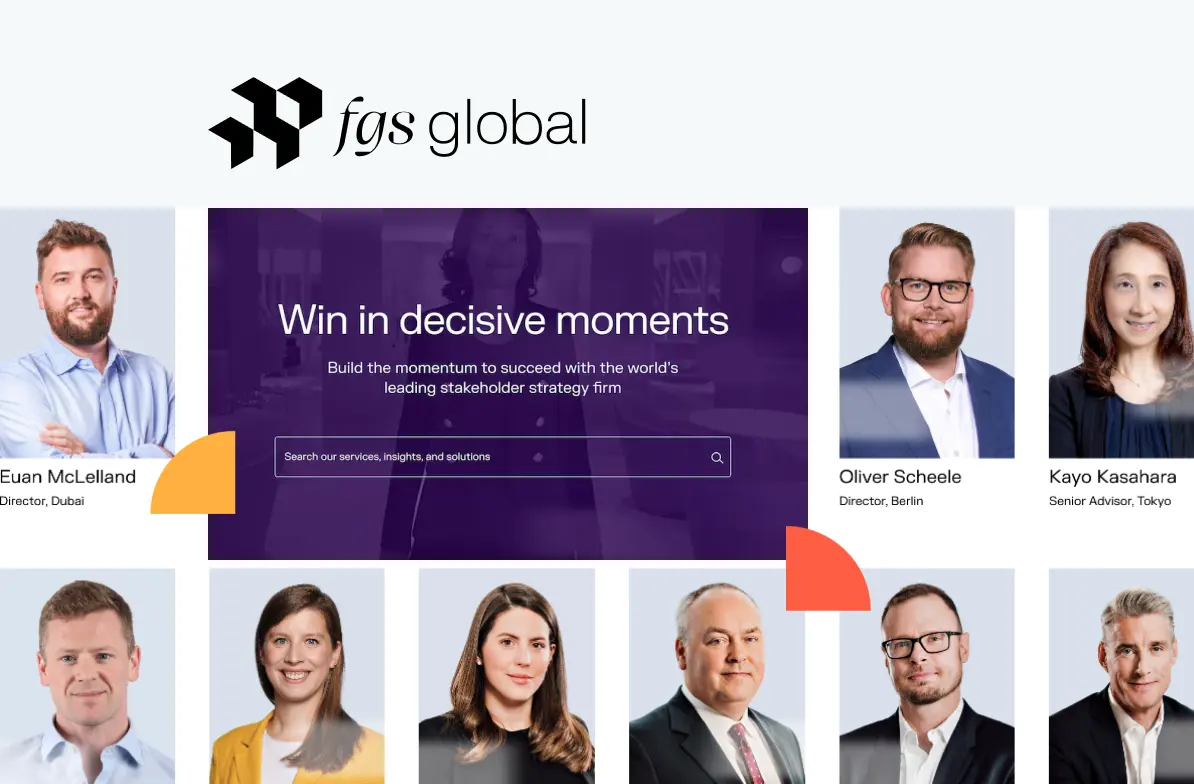
For clients like FGS Global, Naturaily didn’t just “launch a new site,” but built a modern, scalable platform with Next.js + Storyblok + Algolia, then stayed on as a long-term partner to keep evolving architecture and content operations.
Concrete Examples of Custom Web Development at Naturaily
Key points
Custom work spans corporate, e-commerce, SaaS and sector-specific platforms.
The pattern is always the same: business pain → architecture → measurable gains.
Corporate & communications – FGS Global
Challenge
Poor performance, complex content management, and limitations in search and multilingual workflows.
Naturaily’s custom approach
Next.js for a fast, robust frontend (SSR/SSG).
Storyblok as a headless CMS with a visual editor and structured components.
Custom Algolia search with fine-grained control over results and redirects.
Outcome
A modern, scalable web platform that supports a dozen editors, complex content and integrations with systems like Greenhouse and MyFGS.
FGS Global needed a secure, flexible website that captured their brand and scaled with their global presence. We built a fast, headless solution that makes updates effortless and brand consistency simple.
5/5
Clutch review
Custom
search engine
1500+
content items migrated
Headless e-commerce - Nanobebe
Challenge
Shopify Liquid theme limited front-end flexibility, complex new product requirements (pre-orders, subscriptions) and scalability concerns.
Naturaily’s custom approach
Headless architecture: Shopify for commerce, Storyblok for content, Next.js frontend.
Atomic design system so marketing and content teams can update layouts safely.
Custom flows for pre-orders and subscriptions tailored to a smart hardware product launch.
Outcome
A modern, flexible e-commerce platform with significantly improved performance, editor autonomy and a 117% performance score increase, supporting long-term growth.
E-commerce growth engine - Beuta
Challenge
Clunky UX, hard-to-use navigation and no good way to support bulk buying, limiting conversion rates.
Naturaily’s custom approach
Deep UX audit and redesign.
Custom Shopify bundle app and savings calculator for large orders.
Clearer content and journeys tailored to the real buying process.
Outcome
A transformed store that functions as a growth engine, including a 22% increase in average order value.
These examples show that “custom web development at Naturaily” is a way of working that combines architecture, UX and content operations to move specific business metrics.
Costs and ROI: How to Think About Budget
Custom costs more upfront but can save money (and headaches) over 3-5 years.
The biggest hidden cost of “cheap” is usually technical debt + replatforms + lost opportunities.
Rates vary globally, and Naturaily often works in hybrid team models.
The truth is that custom development often has a significantly higher initial CapEx than a basic WordPress or SaaS template site. But when you include:
plugin licences,
performance and security fixes,
rebuilds every few years,
lost revenue from poor UX and reliability,
the TCO over 3-5 years frequently favours a robust custom solution for mid-to-large organizations.
On the labour side, 2025 benchmark data shows:
U.S. agencies and senior engineers often bill $100–$250/hour.
Nearshore/offshore teams span roughly $20–$120/hour, with quality converging as global teams adopt the same modern stacks (MACH, AI integration).
Naturaily typically fits into a high-quality, yet cost-efficient European bracket, often using hybrid team structures (core senior architecture + specialized implementation talent) to balance budget and expertise.
The key is not “Is custom cheap?” but “Does the investment make sense given how critical this platform is to our business?”
If your website or app is:
a major revenue driver,
a crucial brand touchpoint, or
an internal system that saves thousands of hours,
then under-investing is usually far more expensive than doing it properly once.
Is Naturaily-Style Custom Web Development Right for You? - A Checklist
Not everyone needs custom - and that’s okay.
If you tick several boxes below, a custom approach is worth serious consideration.
The decision should be framed in terms of risk, opportunity and timeline, not just cost.
You’re probably ready for custom if:
1. Your current site blocks growth
You can’t easily launch campaigns, landing pages or experiments.
Performance issues are hurting SEO and user experience.
2. You need something structurally different
Complex product or pricing, multi-step quotes, partner portals, self-serve onboarding, etc.
Off-the-shelf flows don’t match your sales process.
3. Security, compliance or data governance are non-negotiable
You’re in regulated industries (healthcare, fintech, logistics, energy) or handle sensitive data.
4. You operate across countries, brands or channels
Multiple sites, languages and markets that must stay consistent yet flexible.
You want omnichannel content (web, apps, terminal screens, AI assistants) managed from one structured system.
5. You care about AI and LLM visibility
You want your content and data to be indexable, trustworthy and controllable in AI tools.
You see the website as part of a broader AI-powered digital ecosystem, not an isolated brochure.
If you don’t tick many of these yet, a well-implemented template and standard stack may be the smarter move for now. And Naturaily can still help you set that up in a way that’s future-proof and migratable.
How Naturaily Frames “Custom Web Development” Going Forward
Putting it all together:
At Naturaily, custom web development means designing and building digital platforms that your business can genuinely own - in performance, security, user experience and AI-readiness - instead of renting a generic solution and fighting its limits.
It’s about:
Ownership of code, data and customer experience.
Differentiation - standing out in markets where everyone else uses the same few templates.
Adaptability - being able to change direction quickly as your business, tech and customer expectations evolve.
If that sounds like the kind of website or platform you want, then “custom web development at Naturaily” is simply the disciplined, technology-agnostic way we help you get there. Contact us today!
Have a project in mind?
Tell us about your goals, budget and timeline. We’ll suggest a custom web setup that fits your business, not the other way round.