Web Development Consultation: How It Can Accelerate Your Business
Marketing spends more to get the same results. Sales teams chase colder leads. Product teams ship features but conversions stay flat. And everyone has that same quiet suspicion: “Our website should be doing more than this.” That is exactly what a web development consultation is for.

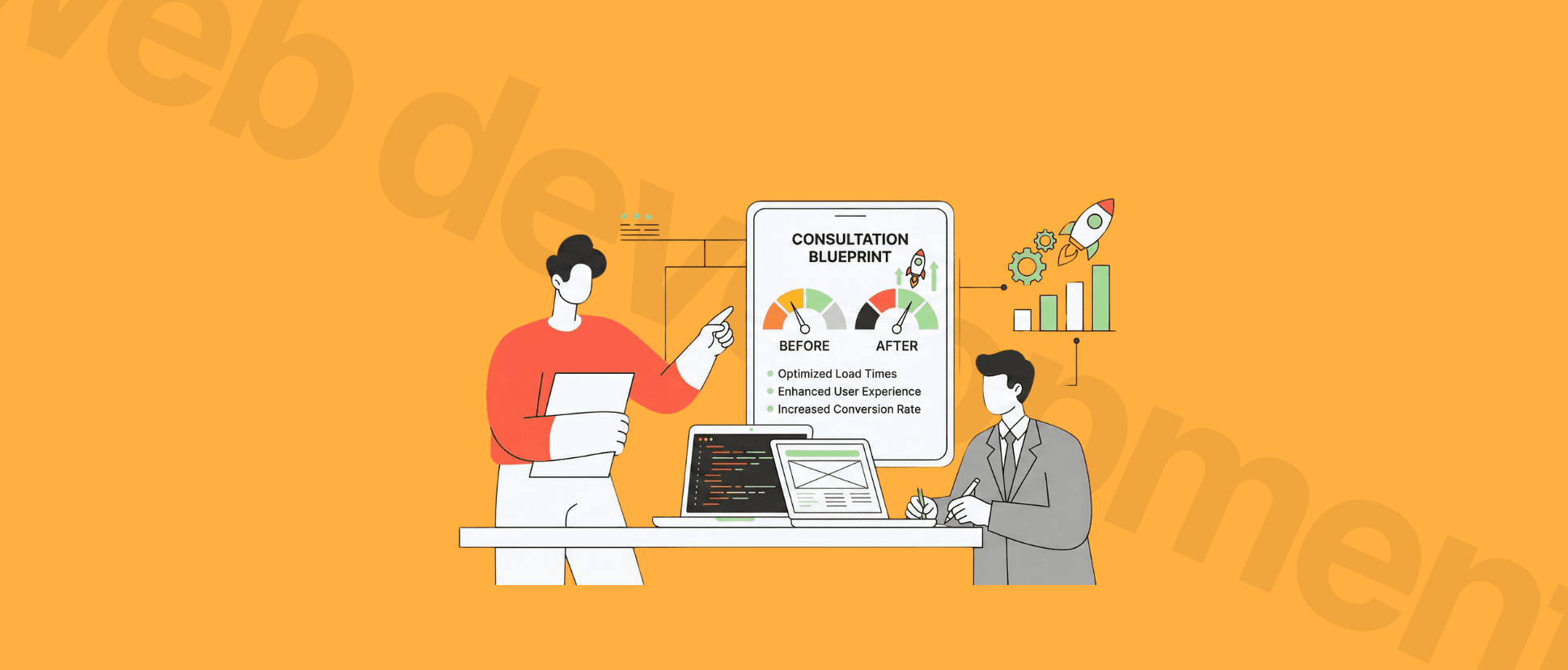
It is not “a quick look” and a list of generic recommendations. A good consultation connects the dots between your business goals and what your website is actually doing today. Then it gives you a clear plan to fix what is slowing you down and build what will help you grow.
Global spending on digital transformation is projected to reach $3.9 trillion by 2027, reflecting how much businesses are investing in modernizing their digital operations. But investing in technology is only part of the equation. Without a clear understanding of what's working, what's holding the business back, and where improvements will have the greatest impact, even substantial investments can fail to deliver the expected results. That's where web development consulting can make a difference.
In this guide, I will walk you through:
What a web development consultation is (in plain language)
What a website development consultant assesses and why it matters
What you should expect as deliverables (and what to avoid)
Typical timelines and costs
How Naturaily runs consultations and what real value you get
FAQs you can send to your team before booking
If you want your site to load faster, convert better, rank higher, and scale without drama, keep reading.

Your website should deliver measurable results
Let’s audit what is underperforming, uncover missed opportunities, and define a plan that improves speed, conversions, and scalability.
What Is a Web Development Consultation?
A web development consultation is a structured review of your website and your goals, followed by a practical plan for improvement. A consultation usually covers both strategy and execution-level details, like:
UX and conversion flow
Performance and Core Web Vitals
Technical SEO foundations
Architecture and scalability
Accessibility and compliance risk
Security basics
Analytics and measurement
Most importantly, it turns “opinions” into decisions. You stop guessing. You get a roadmap.
Think of it like walking into a packed auditorium and saying:
Here is what your website is doing well. Here is what is costing you leads and revenue. Here is what to do first, next, and later. And here is how we will measure success.
When You Should Book a Web Development Consultation
You do not need a consultation only when something is “broken,” but also when the website is underperforming or when you are about to make a high-impact decision.
Common triggers we see (and fix)
You are planning a redesign and do not want it to become an expensive visual refresh.
Your conversion rate is stuck, even though traffic is growing.
Your site feels slow and performance improvements are not sticking.
SEO traffic dropped after a rebuild or platform change.
Marketing needs more landing pages and dev work is a bottleneck.
Your tech stack is aging and releases feel risky.
You want headless CMS, Jamstack, or a modern framework, but want clarity before committing.
You are scaling internationally and your content, infrastructure, and analytics are getting messy.
If any of those sound familiar, a web development consultation is usually the fastest way to reduce risk and regain momentum.
What a Web Development Consultant Actually Assesses
A solid consultation is not just “tech stuff,” but a business outcome, backed by evidence.
Here are the areas a web development consulting engagement typically covers.
1. Performance and speed
A consultant looks at:
Core Web Vitals (LCP, INP, CLS)
Frontend performance issues (render blocking, heavy scripts, images)
Server and hosting bottlenecks
Caching and CDN configuration
Mobile performance, not just desktop
What you get: a prioritized list of improvements with expected impact and effort.
Google and Deloitte Digital analyzed 30 million mobile user sessions and found that a 0.1-second improvement in page load time increased retail conversion rates by 8.4% and lifted average order value by 9.2%.
2. UX, navigation, and conversion flow
Your website might be pretty and still leak customers.
A consultant maps:
Key journeys (home to product, blog to lead, checkout, demo request)
Friction points (confusing navigation, unclear CTAs, form fatigue)
Mobile usability issues
Content hierarchy and “what matters first” logic
What you get: specific UX changes that improve conversion, not vague design opinions.
McKinsey’s five-year study of 300 public companies found that organizations with top-quartile design practices generated 32% more revenue and 56% higher total returns to shareholders than peers.
3. Technical SEO foundations
You can publish amazing content and still lose to competitors if your technical SEO is shaky.
A consultant checks:
Indexing and crawlability
Redirects and canonical setup
Site architecture and internal linking
Schema markup opportunities
Rendering approach (SSR, SSG, CSR) and how it affects SEO
Page templates and metadata patterns
What you get: fixes that support rankings and make content efforts pay off.
4. Architecture and scalability
This is where expensive mistakes usually happen.
A consultant reviews:
Your current stack (CMS, framework, hosting, integrations)
Where you will hit limits as traffic and content grow
Whether headless makes sense for your team and workflows
Integration health (CRM, analytics, product feeds, payments)
Technical debt and release process risks
What you get: clarity on what to keep, what to change, and what to avoid.
5. Accessibility and compliance risk
Accessibility is about customers, usability, and risk reduction.
A consultant assesses:
Common WCAG issues (contrast, keyboard navigation, labels, semantics)
Forms and interactive components
Content patterns that break accessibility at scale
What you get: actionable fixes and a plan to make accessibility part of your workflow, not a one-time panic.
The WebAIM Million audit found 94.8% of the top one million homepages had detectable WCAG 2 failures, averaging 51 errors per page.
6. Security and privacy basics
Even if you are not a bank, you still handle data.
A consultant checks:
Common vulnerabilities and outdated dependencies
Cookie and tracking setup
Basic hardening, headers, and permissions
GDPR-related hygiene (where relevant)
What you get: a short list of security priorities and quick wins.
7. Analytics, tracking, and KPIs
If tracking is wrong, every business decision downstream is compromised.
A consultant reviews:
What you track today (and what is missing)
Event tracking quality and naming
Funnel visibility for key conversions
Reporting that stakeholders actually use
What you get: measurement that supports growth experiments and ROI.
Need a website consultation?
We have been building websites for over 13 years. Let's discuss your challenges and find the right solution.
Web Developer vs Web Development Consultant: The Real Difference
A web developer builds and maintains while a website development consultant makes sure you are building the right thing, in the right way, for the right outcome.
Here is the simplest way to remember it:
Developer: “I can implement this feature.”
Consultant: “Here is whether this feature will move the needle, what it will cost to maintain, and the best way to ship it without breaking the funnel.”
The best outcomes happen when strategy and execution are connected. That is why consultations work best when the people advising you also understand real-world implementation.
What You Get From a High-Quality Web Development Consultation
If you are paying for consulting, you should walk away with assets you can use.
Deliverables you should expect
Audit summary in plain language (what matters, what does not)
Prioritized roadmap (quick wins, mid-term improvements, long-term architecture)
Impact vs effort scoring so you can make decisions fast
Clear recommendations for UX, performance, SEO, and stack
Technical notes that your dev team can act on
Risks and tradeoffs so stakeholders stop debating in circles
Next steps for implementation, with suggested milestones
If a consultant cannot translate recommendations into decisions, it is not consulting, but commentary.
How Naturaily Runs a Web Development Consultation
Naturaily is a web development consultancy that focuses on building websites and web apps that perform, scale, and convert.
We have been building digital products for over 13 years, and we run consultations in a way that respects how businesses actually work: limited time, multiple stakeholders, real constraints.
Our consultation is designed to answer four questions
What is blocking growth today?
What will unlock the biggest improvement with the least effort?
What should the architecture look like for the next 12 to 24 months?
How will we measure success, not just “ship changes”?
What happens during the consultation
Step 1: Discovery call (60 minutes)
We align on:
Business goals and conversion goals
Target audiences and key journeys
Current pain points and constraints
What success looks like in metrics
Step 2: Audit and analysis (typically 2 to 5 working days)
We review:
Performance and Core Web Vitals
UX and conversion flows
Technical SEO foundations
CMS and content workflows
Scalability and integration health
Accessibility and risk areas
Analytics and measurement quality
Step 3: Roadmap and recommendations (typically 1 to 3 working days)
You get:
A prioritized plan
Clear tradeoffs
Implementation approach options
Notes for your team, or our delivery team if you want us to build it
Step 4: Workshop (optional, highly recommended)
We answer questions, align stakeholders, and turn the roadmap into a plan your team actually supports.
The Real Business Value: What Improves After Consultation
Let’s make this concrete. Here is what clients usually gain when the roadmap gets implemented.
More leads without increasing ad spend
Cleaner landing page structure
Better forms and CTAs
Faster page loads
Less friction in key journeys
Better SEO outcomes from the same content effort
Indexing and rendering problems solved
Stronger internal linking and information architecture
Technical patterns that scale across templates
Faster shipping with fewer headaches
Reduced technical debt
Better tooling and clearer architecture decisions
Fewer “surprise” regressions during releases
A site that scales with your business
A stack and CMS setup that supports growth
A realistic plan for integrations and future features
Less rebuild pressure every 18 months
Web Consulting Services: Timeline and Cost Expectations
Costs vary by depth, scope, and complexity. A simple consultation is not the same as a full multi-site audit with workshops and technical architecture planning.
Typical timeline
Discovery call: 1 hour
Audit: 2 to 5 working days
Roadmap: 1 to 3 working days
Workshop: 60 to 120 minutes
So, in many cases, you get a full set of recommendations in less than two weeks.
Typical cost range (Europe)
Many teams see consultation pricing in the $2,000 to $10,000+ range depending on scope.
At Naturaily, we often start with an initial analysis and proposal as the first step toward a partnership, so you can see real thinking and direction before committing to a bigger engagement.
If you want a clear estimate fast, the easiest path is a short call and a look at your current site and goals.
Get a powerful website you deserve
Learn how we deliver web development solutions that help you grow.
How to Choose the Right Web Development Consultant
If you are evaluating a website development consultant or agency, here is what to look for.
1. Evidence of outcomes, not just pretty websites
Ask for:
Case studies with metrics
Before and after performance work
Examples of UX changes that improved conversion
2. Ability to explain decisions clearly
If they cannot explain the “why” in simple language, you will struggle to align stakeholders.
3. Comfort with tradeoffs
Every recommendation has a cost. A good consultant shows you options and consequences, not a single “perfect” answer.
4. Implementation credibility
Even if they only consult, they should understand how long things take, what breaks, and what maintainability really costs.
Ready for a Website Consultation?
If you want a website that loads fast, ranks well, and converts consistently, a web development consultation is the quickest way to get a plan you can trust.
Naturaily can help you:
Identify quick wins that improve leads and conversions
Fix performance and technical SEO blockers
Choose a stack that scales without rebuild pain
Improve UX with measurable outcomes
Build a realistic roadmap your team can execute
The ROI of investing in design and UX is well-documented: McKinsey's research shows 32% higher revenue for top design performers, Baymard's data reveals a 35% conversion uplift from checkout improvements alone, and Google's research proves that even tiny speed gains translate to measurable revenue increases.
The consultation process typically takes less than a week for the analysis and strategy phase, and costs start around $2,000 in European markets. Some agencies, like Naturaily, offer the initial consultation at no charge.
FAQ
Web Development Consultation
Usually: performance audit, UX and conversion flow review, technical SEO foundations, stack and scalability review, accessibility checks, and analytics measurement review. The key deliverable is a prioritized roadmap.
Commonly 1 to 2 weeks end-to-end depending on scope, including the audit and roadmap presentation.
Not always. Many issues can be diagnosed from public data and analytics screenshots. For deeper technical recommendations, read-only access to the repo and hosting setup can help.
No. Smaller teams often benefit the most because they cannot afford expensive rebuild mistakes. Consulting helps you choose the right stack and focus on high-impact work.
Absolutely. A consultation can give your team a clear plan and remove uncertainty. Many clients use the roadmap as a blueprint their internal team executes.
Yes, especially if your SEO issues are technical. A consultation typically covers indexing, rendering, site structure, metadata patterns, performance, and schema opportunities.
If you have them, bring:
Your main website goal (and how you measure it)
Top conversion actions (leads, demo requests, purchases)
Access to analytics or key reports
A list of known pain points and stakeholder opinions
Even without these, we can still start. Preparation just makes the consultation sharper.
You can implement the roadmap with your internal team, with Naturaily, or with a hybrid approach. The point is that you will finally know what to do first and why.
Need a web development consultation?
Let’s identify what is limiting your website’s performance and define a clear, prioritized roadmap for growth.