AI Copywriting: Do You Still Need a Copywriter?
AI copywriting means drafting marketing copy with a language model. You still need a copywriter, because the model writes from what it already knows. It cannot quote your sales calls, name your customers, or commit to a position a buying committee will repeat internally. Draft with AI, then have a person rewrite every line.

Table of contents
What is AI copywriting?
AI copywriting is the practice of producing marketing copy with a large language model such as ChatGPT, Claude or Gemini. You write a brief, the model returns sentences, and you edit or ship them.
Teams reach for it in four places: first drafts, variations on a headline, cutting long sections down, and bulk work like meta descriptions across a few hundred pages.
Output quality is rarely the problem. The sentences read fine. Whether they do any work on the page is a separate question, and that is what this post is about.
What AI copywriting does well
A post arguing for human writers that concedes nothing is worth ignoring, so here is the honest list.
First drafts of a page you have already scoped and structured
Twenty variations of a headline once you have one that converts
Cutting a 400-word section to 150 without losing the argument
Meta descriptions, alt text and button labels across hundreds of pages
Summarising research you gathered somewhere else
If you run marketing with three people and sixty pages to ship, that list saves you weeks. Anyone who tells you to ignore it has not shipped sixty pages.
Where AI-only copy breaks
AI-only copy fails in three places, and all three sit on the pages closest to your revenue: the homepage, the pricing page, the product page.
It has no evidence of its own
A model writes from what it reads during training. It never sat on your sales calls, never read your support tickets, never heard the objection your best rep answers four times a week.
So it produces the average of everything written about your category. That average contains no customer names, no numbers from your own product, and no story about the thing that went wrong in month two of an implementation. Buyers skim for exactly those details, because details are the only part of a website they cannot get from a competitor.
It will not take a side
Ask a model to write about your pricing and its hedges. Ask which of two approaches is better and it explains that the answer depends.
Hedged copy is safe and useless. A buyer reads it, agrees with all of it, and leaves with nothing to repeat to the colleague who controls the budget. Copy that works says one thing clearly enough that a reader could disagree with it.
It writes a page, not a path
Generated copy treats each page as an isolated block of text. Real pages sit inside a journey: the reader arrived from a comparison post, scrolled past two objections, and is now deciding whether to fill in a form.
A copywriter maps the objection at each scroll depth and answers it before the buyer bounces. That mapping needs someone who knows which click came before this one.
Here's the shift, illustrated with a typical product page line:
AI draft: "Our software helps businesses improve efficiency and drive growth through innovative solutions tailored to their unique needs."
Edited by a copywriter: "You upload a spreadsheet. Fourteen seconds later, it's a searchable database your support team can query without waiting on engineering."
The first sentence could sit on any B2B homepage in any category. The second only fits one product, because it names what the product actually does and how long it takes.

Working on a page that has to convert?
Our website copywriting work starts with your sales calls, not with a prompt.
AI copywriting vs a copywriter
| AI on its own | AI plus a copywriter | |
|---|---|---|
| Time to first draft | Minutes | Hours |
| Original evidence | None | Sales calls, support tickets, customer interviews |
| Position | Hedged | Stated and defensible |
| Fit to the page | Generic block | Mapped to scroll depth and the next action |
| Odds of being quoted in an AI answer | Low, it repeats known material | Higher, it adds something |
The row that decides most budgets is the last one, and it is the one teams check least.
Does AI-written copy rank and get cited?
An AI assistant reading your page has the same problem your buyer does. It is deciding whether your page adds anything to an answer it could already write.
Generated copy repeats what the model already knows, so quoting it adds nothing. A page with an original number, a named customer and a stated position gives the assistant a reason to cite you by name. That citation is now the visibility, because the reader may never see a list of blue links.
Share of AI voice varies a lot by assistant. Our own tracking puts ChatGPT at 81%, Perplexity at 69%, Google AI Overviews at 62%, and Gemini at 55%. The gap between assistants is one more reason to check where your buyers are actually asking, rather than optimising for one engine and assuming the rest follow.
The structural work matters as much as the words. Headings phrased as questions, a self-contained answer near the top, a real HTML comparison table and FAQ schema all make a page easier to quote. We wrote about the mechanics in answer engine optimization.
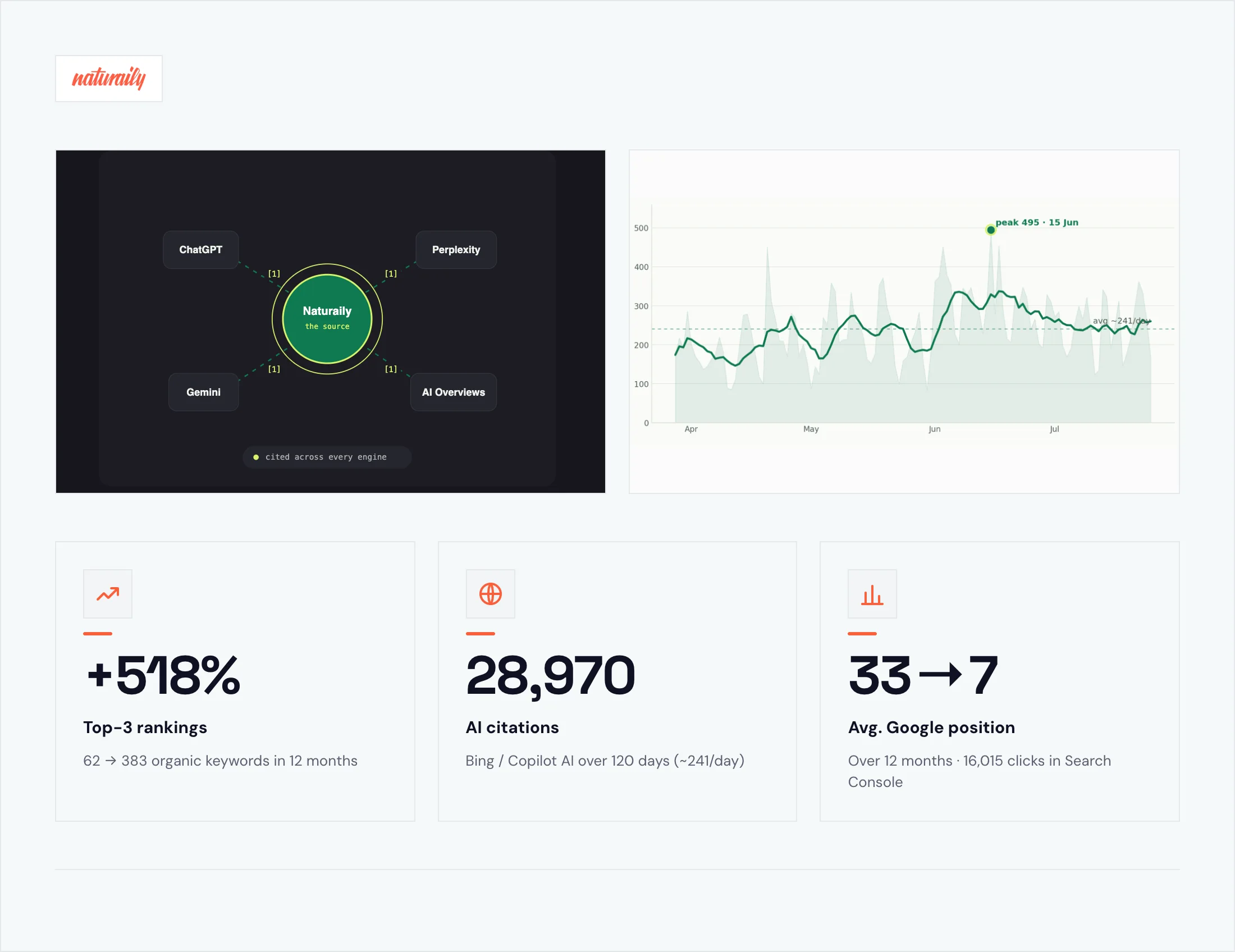
Naturaily ran this same argument on its own site. Restructuring priority pages with clear definitions, cited numbers and comparison tables pushed top-3 keyword rankings up 518% in a year and made naturaily.com the most-cited agency in its category's AI answers, with 28,970 citations from Bing and Copilot alone over 120 days. The pages earned those citations because they gave an assistant something specific to quote, not because they were longer.
Naturaily
GEO / AI Visibility
Naturaily ran its own GEO, SEO, and copywriting playbook on naturaily.com and became the most-cited agency in its category's AI answers. Twelve months in, ChatGPT, Perplexity, Gemini, and Google AI Overviews all quote its pages, and its average Google position climbed from 33 to 7.
#1
Most-cited agency in AI answers
38%
Share of AI voice vs. every named competitor
DR 48 → 55
Domain Rating in 12 months
Should you hire a copywriter? Five questions
Answer these about the page you care about most.
Does the page contain a number, a name or a quote that no competitor could copy onto their own site?
Could a reader disagree with anything on it?
If you deleted your logo, would anyone know whose page it was?
Do you know which objection the reader has at the moment they reach your form?
When you ask ChatGPT or Perplexity a question your product answers, does your page come back?
Three or more noes means the problem is not your writing tool. It is that nobody has decided what the page argues.
You can fix that yourself. Sit in on four sales calls, write down the objection that keeps repeating, and answer it in the first screen of the page. Most teams find that faster than hiring.
Bring in a writer when the page carries real revenue, when the argument has to hold up in front of a buying committee, or when nobody internally has the week it takes to do the research.
How we write with AI at Naturaily
We use AI to research and draft faster, then a copywriter rewrites every line. The process runs in four steps.
Research. We read your sales calls, docs and competitors, and talk to the people who close deals.
Positioning. We agree on who the copy is for, what it promises and the one action it drives.
Draft. You get copy written by a person, mapped to each page and heading, ready to review in context.
Test and iterate. We ship, watch how buyers and AI answers respond, and rewrite what underperforms.
The tools speed up the work around the argument. A person makes the argument. That distinction is also why we build AI content agents for clients who want to scale production without shipping unedited output.
We also build the page. Copy arrives inside a fast headless build with the heading structure, schema and internal links already set, which is the part most agencies split across two vendors.
FAQ
Questions about AI copywriting
No. AI produces fluent sentences from material it already saw, which covers drafting and editing. It cannot gather original evidence from your customers or commit to a position. Teams that replace writers outright tend to publish more pages and get less from each one.
Google ranks content by usefulness rather than by how it was produced. Generated content often ranks poorly because it repeats what already exists, adds no original information, and matches hundreds of near-identical pages. Edited, evidence-backed content built on the same tools performs differently.
AI copywriting describes the tool used to produce the words. SEO copywriting describes the goal: copy written to rank in search and convert the reader who arrives. You can do SEO copywriting with AI assistance, or without it.
Give the assistant something it cannot generate itself. Publish original numbers, named examples and a clear position, then structure the page so it can be extracted: question headings, a short self-contained answer near the top, a real table, and FAQ schema.
Search engines do not require it. Buyers increasingly ask. Stating how you use AI, and where a person takes over, costs nothing and answers a question your prospects are already asking about every vendor they consider.
Naturaily is a copywriting and web-development agency. We write and design product content, then ship it inside fast, headless builds on Next.js, Storyblok, Sanity, and Payload.
Tell us what needs to convert
Tell us the flow that is confusing people. We reply with an approach, scope, and a fixed estimate inside a week.
Naturaily is a copywriting and web-development agency. We write UX copy and conversion copy, then ship it inside fast, headless builds on Next.js, Storyblok, Sanity, and Payload.