Greenfield vs Brownfield IT Projects: Dey Differences, Costs, Risks and Use Cases
A greenfield project is software built from scratch, while a brownfield project is developed on top of an existing system. The difference between them comes down to flexibility versus speed, as well as how much risk and complexity a team is willing to manage. This article compares greenfield and brownfield approaches in terms of costs, risks, timelines, and practical use cases.


Updated on May 5, 2026
Greenfield means building from scratch
More flexibility, scalability, and innovation, but higher costs, longer time-to-market, and bigger risks.Brownfield means building on existing systems
Lower entry costs, shorter time-to-market, but limitations due to legacy code, technical debt, and integration challenges.
Greenfield vs brownfield: core differences
| Factor | Greenfield | Brownfield |
|---|---|---|
| Definition | Build a system from scratch | Build on existing systems |
| Cost (initial) | High | Lower (but variable) |
| Cost (long-term) | Lower (less tech debt) | Often higher (maintenance, complexity) |
| Time to market | Slower | Faster (if system is stable) |
| Flexibility | Very high | Limited by legacy constraints |
| Delivery risk | High early uncertainty | High complexity over time |
| Technical debt | None at start | Inherited + often grows |
| Best use case | New product, broken legacy, innovation | Incremental improvements, stable systems |
Greenfield maximizes flexibility and long-term scalability, while brownfield prioritizes speed and cost efficiency, but at the expense of constraints and hidden complexity.
Rule of thumb:
Choose greenfield when your system blocks growth
Choose brownfield when your system still creates value
What is a greenfield project?
A greenfield project is software development built entirely from scratch, without relying on existing code, infrastructure, or constraints.
This approach is typically used when:
launching a new product
replacing an outdated system
building for scalability from day one
At this stage, teams usually start with proper validation and planning, which is a key part of the custom web development process.
What is a brownfield project?
A brownfield project extends or modernizes an existing system by reusing parts of the current architecture.
Typical use cases include:
adding new features
integrating new services
gradual modernization
In practice, this often overlaps with modernization and UX improvements.

Stuck between rebuilding and modernizing?
Most teams spend weeks on this decision. A 30-minute call with our architects cuts it to one.
Which is cheaper: greenfield or brownfield?
Brownfield is usually cheaper upfront.
However, this assumption often breaks down due to:
integration complexity
legacy constraints
technical debt
Greenfield requires higher initial investment but often delivers better long-term ROI.
Delivery risk: greenfield vs brownfield
Most comparisons oversimplify risk as “higher vs lower.” In reality, each model fails in different ways.
Greenfield risk profile
Product-market misalignment
Incorrect architecture decisions
Budget overruns due to unknowns
Longer validation cycles
Brownfield risk profile
Hidden technical debt
Integration failures
Poor or missing documentation
Dependency bottlenecks
Increasing system complexity over time
Key insight:
Greenfield risk is front-loaded (strategic)
Brownfield risk is accumulative (technical)
This is why many brownfield projects appear safe initially, but degrade over time.
Budget and timeline considerations
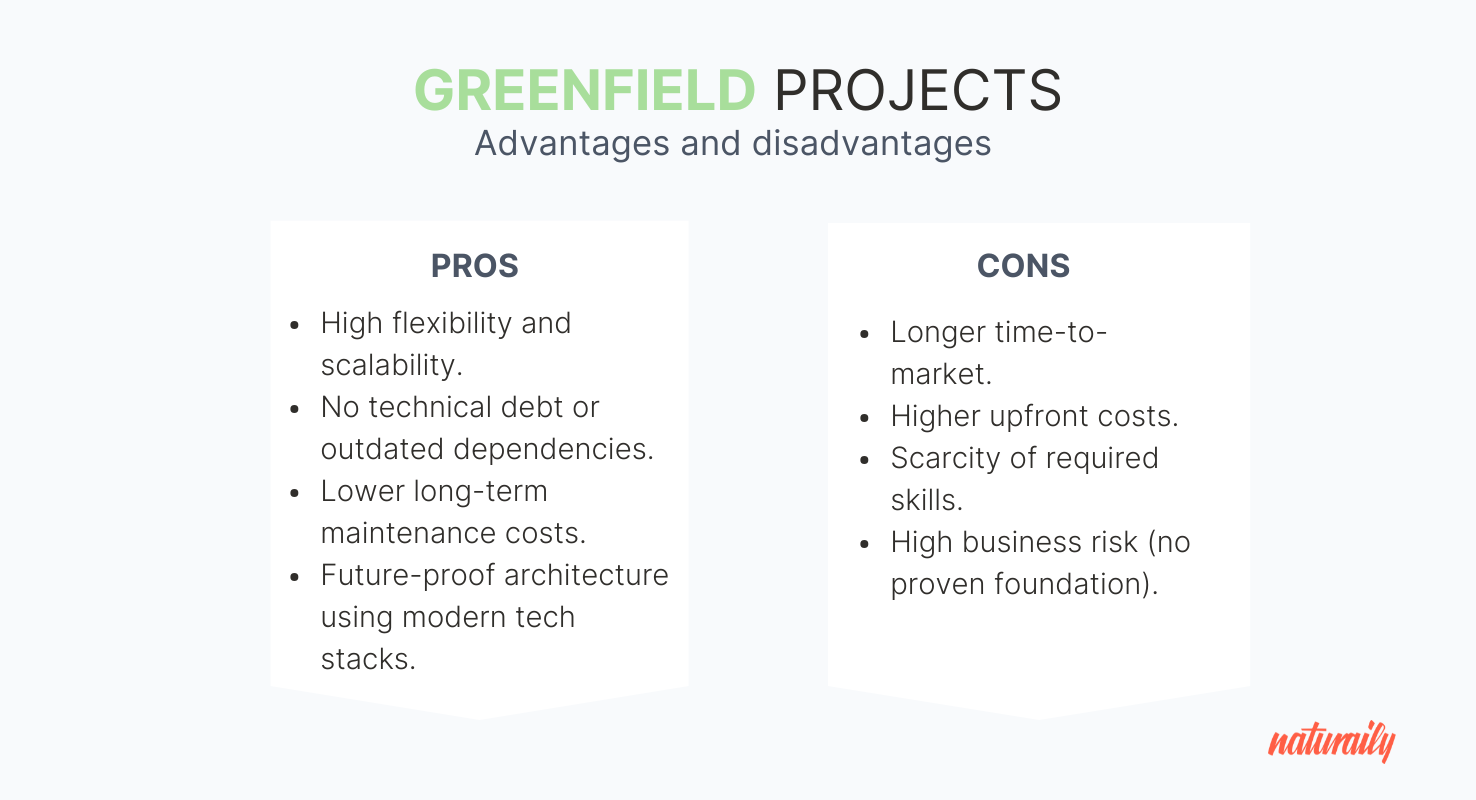
Greenfield
Higher initial investment
Longer development timeline
Predictable architecture
Lower maintenance costs over time
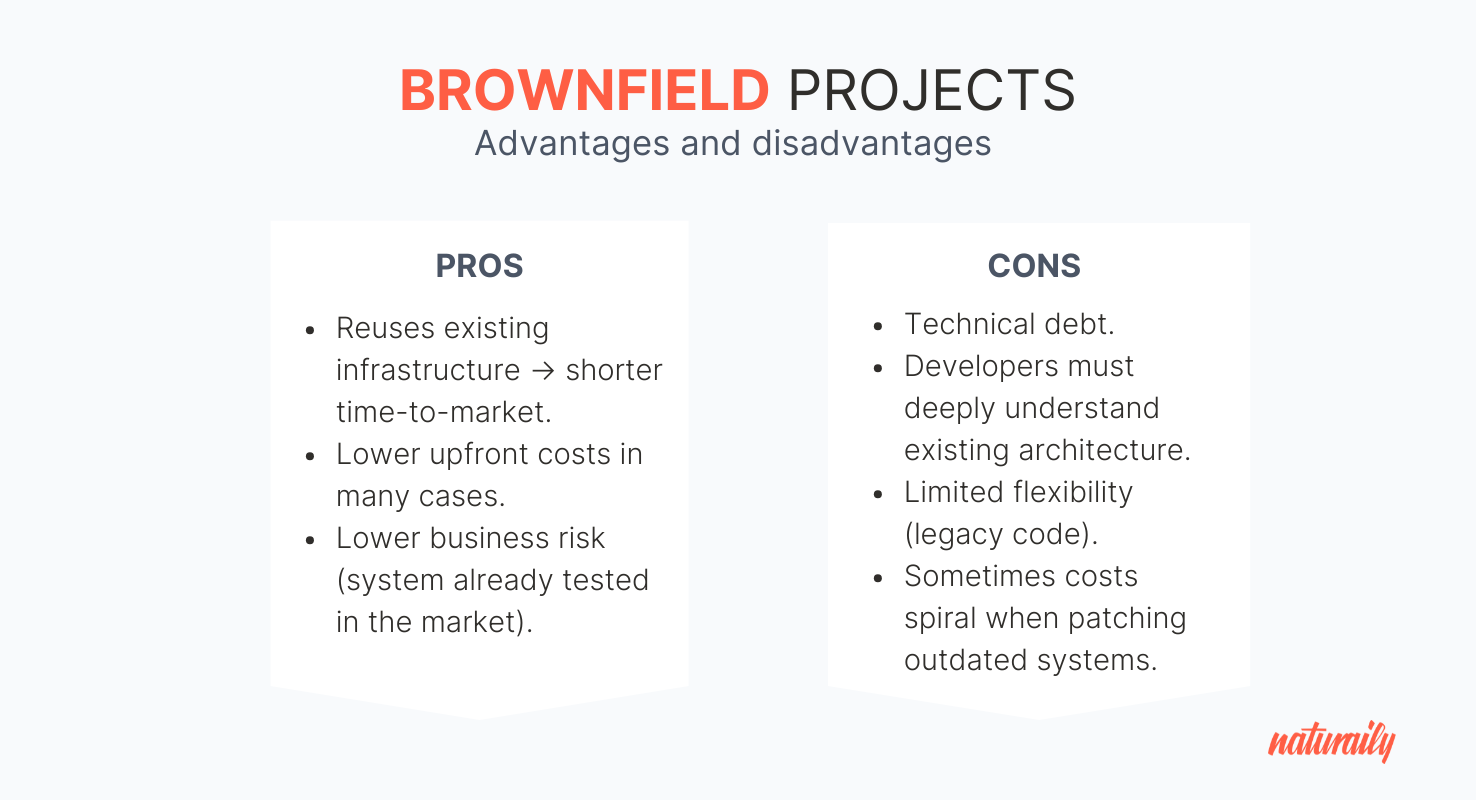
Brownfield
Lower entry cost (in theory)
Faster initial delivery
Costs often increase due to: refactoring, integration issues, legacy constraints
Typical pattern:
Greenfield → expensive early, stable later
Brownfield → cheaper early, volatile later
If you're unsure which path is more cost-effective, start with a software product strategy and discovery phase to validate assumptions before committing.
When to choose greenfield vs brownfield
Go for greenfield if:
your system is outdated or blocking growth
technical debt is significant
compliance or security requires rebuilding
you're building a new product or entering a new market
Go for brownfield if:
the system is stable and valuable
changes are incremental
downtime must be minimal
time-to-market is critical
Choose the right path before you invest
Avoid costly mistakes. Our team will evaluate your current system and help you decide whether to rebuild or modernize – based on real ROI, not assumptions.
Greenfield vs brownfield: a decision framework
When choosing between greenfield and brownfield, use this decision matrix:
| Scenario | Recommended approach | Reasoning |
|---|---|---|
| Existing system works well but needs a few extra features (e.g., new payment method in an e-commerce platform). | Brownfield | Extending the current system is faster, cheaper, and less disruptive. |
| Existing system is outdated, poorly documented, or overloaded with technical debt. | Greenfield | Rebuilding from scratch provides a clean slate, removes technical debt, and creates a scalable foundation. |
| Startup launching a brand-new SaaS product in a competitive market. | Greenfield | Allows complete flexibility and ensures the product is tailored to business goals from the beginning. |
| Enterprise needs to modernize while ensuring minimal downtime (e.g., ERP or CRM with ongoing operations). | Brownfield with selective refactoring | Incremental improvements reduce risk of disruption while still improving performance. |
| Legacy system with critical security or compliance issues (e.g., healthcare or banking software). | Greenfield | Meeting compliance requirements often makes rebuilding the smarter investment. |
| Company expanding into new markets but wants to reuse parts of existing infrastructure (e.g., adding a regional site or app). | Hybrid Brownfield/Greenfield | Selective reuse of stable modules combined with greenfield components balances speed and scalability. |
| Short-term need to test a new feature or product idea (proof of concept or MVP). | Greenfield (MVP) | Starting from scratch enables faster iteration and validation without being slowed down by legacy code. |
| Enterprise system migration to cloud (e.g., moving on-premise legacy systems to AWS or Azure). | Depends on audit: Greenfield if legacy is outdated; Brownfield if system is stable | A code audit determines whether it’s cheaper and faster to rebuild or replatform. |
| Business wants to reduce licensing costs from outdated proprietary software. | Greenfield | Open-source or modern alternatives often require rebuilding instead of patching the old system. |
| Rapid feature competition (e.g., retail or e-commerce during seasonal peaks). | Brownfield | Extending existing platforms ensures faster time-to-market under tight deadlines. |
Real case studies: when each approach wins
Greenfield example (SaaS scaling)
n8n, a workflow automation company, needed a scalable web platform to support rapid growth.
Instead of extending an existing system, we built a greenfield architecture using Nuxt.js, API integrations, and hybrid rendering with caching.
Outcome:
over 300% increase in organic traffic
900% growth in Top 10 keywords
Core Web Vitals score of 100
scalable content operations without developer dependency
n8n
Workflow automation SaaS
n8n needed to generate hundreds of thousands of pages without sacrificing performance or visibility. We built a scalable, Nuxt.js-based architecture that supports high-volume, API-driven content while maintaining strong Core Web Vitals and SEO foundations.
5/5
Clutch review
300k
API-driven dynamic pages generated
900%
increase in Top 10 keyword rankings within 12 months

Brownfield example (e-commerce automation)
Nerdy Banana, a UK-based e-commerce agency, relied on manual processes within their existing Shopify setup.
Rather than rebuilding, we:
extended the current system
added automation for print file generation
improved workflows with a live product configurator
Outcome:
production time reduced by 95% (48h → 5 min)
delivery time reduced from 5 days to 1 day
conversion rate increased from 3.6% to 4.9%
Nerdy Banana
Apparel e-commerce
We built a custom product personalization flow that reduced file preparation from 24 hours to 10 seconds and sped up delivery for a growing e-commerce brand.
3x
Quicker delivery times
95%
Production lead time saved
98%
Faster file preparation time

Enterprise example (replatforming decision)
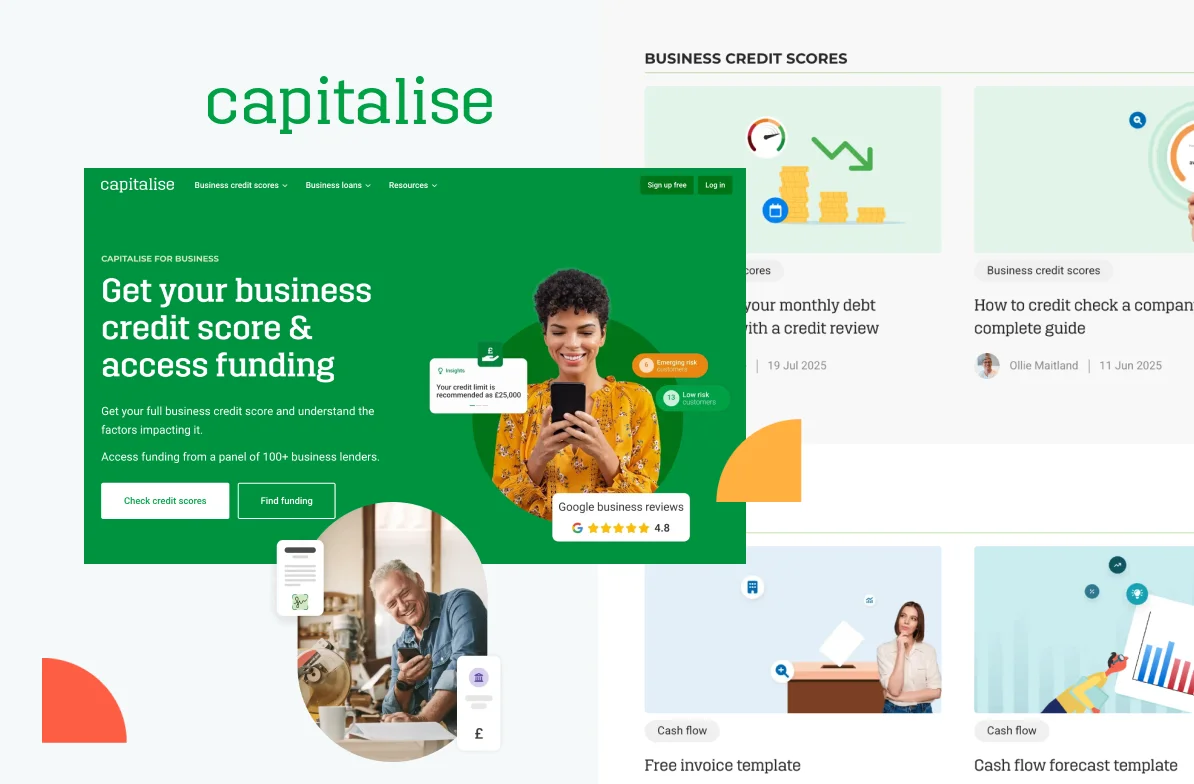
Capitalise, a financial services company, struggled with an outdated Pimcore system that limited performance and content operations.
After analysis, instead of incremental fixes, we moved to a new architecture (Storyblok + Next.js), effectively taking a greenfield approach at the system level.
Outcome:
improved performance and SEO
faster content management
scalable, future-ready architecture
Capitalise
Business finance SaaS
Capitalise needed a modern website to replace their rigid legacy CMS and enable data-driven growth. We created a fast, headless platform with built-in A/B testing. Easy to experiment, optimize, and boost conversions.
48%
growth in average monthly traffic
31%
faster mobile LCP
35%
faster CMS content update
Greenfield vs brownfield in practice
Both approaches apply across:
enterprise software (ERP, CRM)
web applications
The real challenge is choosing the right model. That’s why many organizations start with:
discovery workshops
technical audits
architecture assessments
These reduce decision risk before development begins.
Validate your greenfield vs brownfield decision
Get a clear view of costs, risks, and scalability based on your architecture.
How to run a greenfield project
Greenfield success depends heavily on preparation.
Key steps:
Business analysis – validate problem, users, and market
Strategy – define architecture, stack, and roadmap
Design – UX, flows, prototyping
Development (MVP first) – iterative delivery
Strong alignment between business and engineering is critical.
How to run a brownfield project
Brownfield projects require deeper technical insight upfront.
Key steps:
System audit – understand existing architecture
Gap analysis – define what needs to change
Roadmap planning – prioritize features
Incremental development
Avoid the common trap: rewriting everything.
Best practices
For greenfield
validate business assumptions early
build an MVP first
use modern, scalable architecture
align stakeholders from the start
For brownfield
start with a full system audit
identify technical debt early
plan for hidden costs
prioritize incremental improvements
Should you choose greenfield or brownfield?
There is no universally better option.
The right choice depends on:
system health
business goals
budget constraints
risk tolerance
Organizations that get this decision right typically:
invest in upfront analysis
avoid assumptions about cost
align technical and business priorities
Whether you’re planning a greenfield build or working with an existing system, the key is making that decision based on evidence, not intuition. At Naturaily, we support both paths – from shaping new products from scratch to modernizing and extending legacy systems – helping teams choose and execute the approach that fits their situation.
If you're evaluating your options, start with a structured product strategy process—it’s significantly cheaper than fixing a wrong decision later. If you want to discuss your case, get in touch with our team.
FAQ
Questions and Answers
A greenfield project in software development is one that starts from scratch, with no existing codebase, infrastructure, or legacy system to work around. The term comes from construction, building on land with no prior structures. In IT, it means complete freedom over architecture, technology stack, and design from day one, at the cost of higher upfront investment and longer time to market.
A brownfield project in software development involves building on top of an existing system, codebase, or infrastructure. Development teams work within the constraints of what is already there, integrating new features, migrating components, or modernizing a platform without starting from zero. This typically means faster initial delivery but inherited technical debt and integration complexity.
The core difference is the starting point. Greenfield development starts from zero – no existing code, no legacy constraints, maximum flexibility. Brownfield development starts from something that already exists – faster to launch, lower initial cost, but limited by inherited architecture and technical debt. Greenfield is a blank canvas; brownfield is a renovation.
Brownfield is cheaper to start. It reuses existing infrastructure and code, which reduces initial spend and shortens time to market. However, hidden costs – undocumented systems, integration failures, security vulnerabilities in old dependencies, and accumulated technical debt – routinely make brownfield more expensive over a 3–5 year horizon. Greenfield costs more upfront but typically delivers lower total cost of ownership when the existing system is significantly outdated.
Greenfield carries higher upfront business risk: no proven foundation, and scope creep or wrong technology choices compound early. Brownfield carries lower risk for incremental changes but becomes high-risk when the legacy system is brittle, poorly documented, or loaded with technical debt. The risk profile differs in timing – greenfield risk peaks early; brownfield risk surfaces throughout the project.
Brownfield is faster to start – the existing foundation reduces planning and setup time. That advantage narrows when the legacy codebase is complex or poorly documented, as discovery and audit phases can consume weeks before new code is written. Greenfield takes longer overall but avoids the discovery tax.
Choose greenfield when: your existing system is too outdated or costly to extend, compliance requirements force a rebuild, you are launching a genuinely new product with no prior codebase, or the cumulative cost of maintaining legacy systems exceeds the cost of rebuilding. If the existing system has significant technical debt, missing documentation, or blocks innovation, greenfield is usually the better long-term investment.
The best partner for a greenfield project should have proven experience in building software from scratch, deep technical expertise in modern stacks, and a structured process that covers business analysis, strategy, design, and MVP delivery. It’s also important to look for case studies on a company's website, transparent cost estimates, and a track record of scalable solutions. At Naturaily, we specialize in greenfield software development, helping companies transform ideas into successful products with a future-proof foundation.
Start with a code and system audit. If the existing system is stable and extensible, brownfield is usually faster and cheaper. If legacy systems are costly to maintain, create compliance exposure, or block product development, greenfield is the better long-term call. A structured web development consultation with an experienced software partner can surface these answers before you commit a budget.
n8n, a workflow automation SaaS company, is a real greenfield example. With no existing web platform suitable for their growth stage, Naturaily built a Jamstack architecture from scratch using Nuxt.js – including hybrid rendering, API-driven dynamic pages (300,000+), and full SEO infrastructure. The result was 900% more Top 10 keywords in one year.
Nerdy Banana is a real brownfield example. Rather than rebuilding their Shopify store from scratch, Naturaily extended it with a custom AI-assisted product configurator and automated order processing layer. File preparation time dropped from 24 hours to 10 seconds (98% faster) and production lead time fell by 95% – all while preserving the existing platform, integrations, and data.
Yes – this is called a hybrid or composable approach. It reuses reliable, stable components from the existing system while building new modules from scratch. Hybrid is often the right call for enterprise migrations where full downtime is not an option, or where certain platform components (authentication, payments, CMS) are worth preserving while others are rebuilt.
Kickstart your greenfield or brownfield project today
From strategy to implementation, Naturaily will guide you through every step with clarity and confidence.