Next.js for Ecommerce: Architecture, SEO, and Real Builds
Next.js for ecommerce means using Next.js as the storefront layer in a headless or composable commerce stack. The framework handles routing, rendering, and SEO. A separate backend (Shopify, commercetools, or Medusa) handles transactions, inventory, and checkout. Teams pick it for control over rendering strategy and content workflows that traditional themes don't offer.


Next.js fixes rendering problems, but it doesn’t fix product-market fit, pricing, or operational gaps. If those areas are shaky, solve them first. Use Next.js to scale what already works.
Next.js is one of the strongest choices for ecommerce storefronts that need SEO performance, flexible rendering, and composable architecture – but it adds real complexity that not every team is ready to own.
✅ Hybrid rendering (SSR, SSG, ISR) gives you precise control over page freshness, SEO indexability, and caching – by page type, not globally.
✅ Hybrid rendering (SSR, SSG, ISR) gives you precise control over page freshness, SEO indexability, and caching – by page type, not globally.
✅ Headless-ready by design – works cleanly as the storefront layer in front of Shopify, commercetools, Medusa, or any composable commerce backend.
✅ Strong CMS integration – supports preview mode, webhook-driven revalidation, and fast publishing workflows that content teams can run without developer deploys.
✅ Built for Core Web Vitals – image optimization, edge caching, and JavaScript budget control are first-class, not afterthoughts.
✅ Multi-market ready – middleware, App Router, and edge rendering handle localization, currency routing, and regional SEO at scale.
❗ Not the right fit for every store – smaller catalogs with simple SEO needs are usually better served by a managed Shopify storefront.Hybrid rendering (SSR, SSG, ISR) gives you precise control over page freshness, SEO indexability, and caching – by page type, not globally.
Is Next.js good for ecommerce?
Yes, for SEO-driven ecommerce, headless ecommerce, content-heavy storefronts, composable architecture, and multi-market operations.
Next.js fits when businesses need:
SSR, SSG, and ISR flexibility
Better Core Web Vitals
Advanced CMS workflows
Frontend control beyond traditional ecommerce themes
For smaller stores with simple catalogs and limited content operations, traditional Shopify is cheaper to run and easier to maintain. The question worth asking: does your business complexity justify headless frontend architecture? If category pages, content workflows, and international SEO drive revenue, go headless. If they don't, stay on Shopify.
What is Next.js in ecommerce terms?
In a Next.js ecommerce build, the framework handles three things:
Routing - URL structure, dynamic segments, internationalization
Rendering - SSR, SSG, ISR, streaming
Performance - image optimization, code splitting, edge delivery
Everything else lives in the backend: Shopify, commercetools, Medusa, or a custom commerce engine. That includes transactions, inventory, checkout, payment processing, and order management.
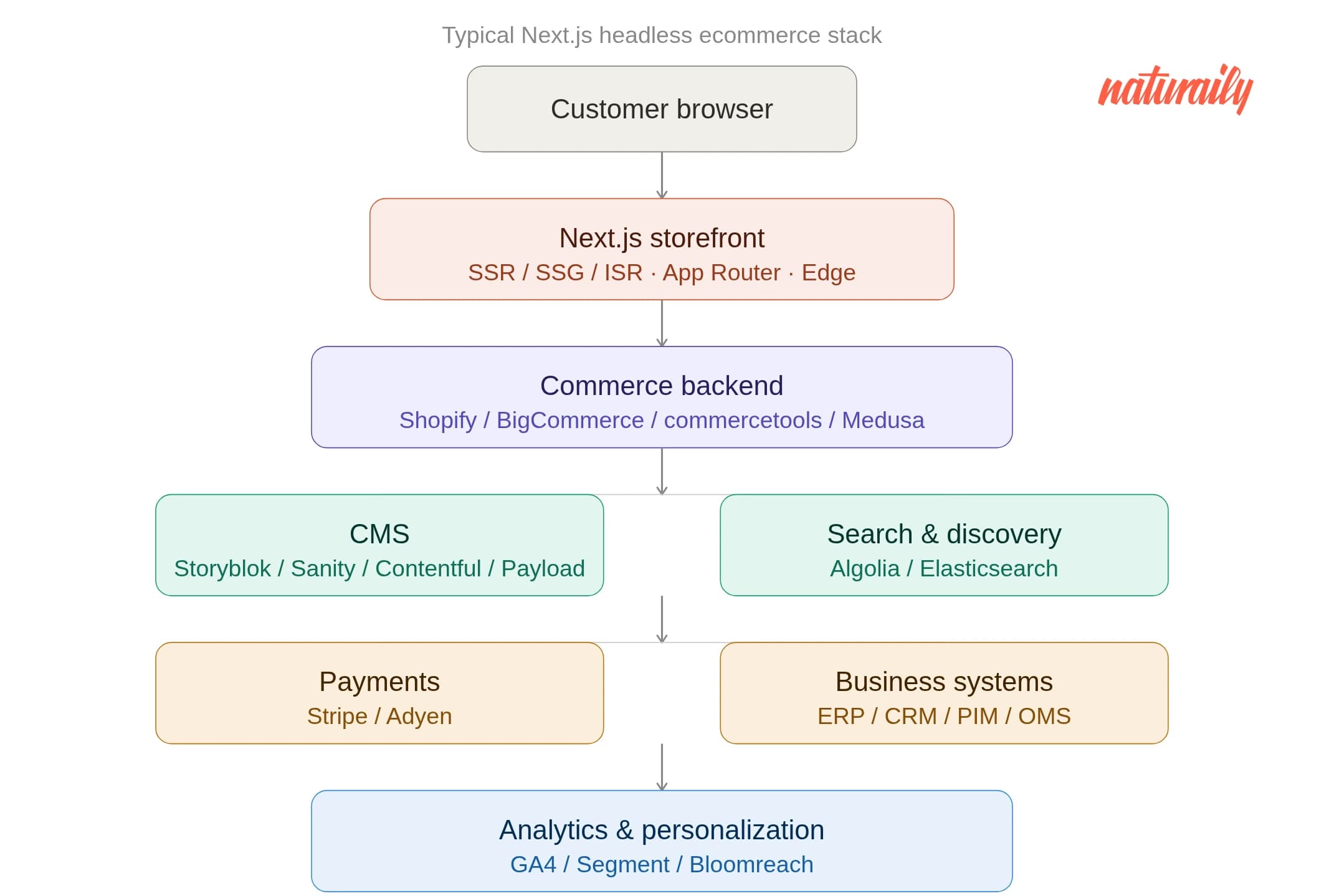
This split became standard because ecommerce now overlaps with content operations, personalization, localization, analytics, and omnichannel delivery. A single monolithic platform struggles with all five at once.
Why do ecommerce teams use Next.js?
Three shifts drove adoption:
Teams hit the limits of client-side React storefronts: slow hydration, weak indexing, oversized JS bundles, poor mobile performance.
Hybrid rendering (SSR, SSG, ISR) closed the gap between speed and freshness.
Commerce and content operations merged. Editorial teams now ship landing pages, localized campaigns, and product launches that traditional themes can't handle without developer involvement.
A 2025 study presented at ACM WWW '25 found that Next.js outperformed equivalent React implementations on FCP, TTI, and overall page load under real-world network conditions.
This is one of the reasons Next.js became heavily associated with modern ecommerce storefront architecture.
Best Next.js ecommerce setup by scenario
| Scenario | Recommended setup | Why it works |
|---|---|---|
| Shopify SEO-heavy storefront | Next.js + Shopify + headless CMS | Better content and SEO control |
| Enterprise composable commerce | Next.js + commercetools | Strong orchestration flexibility |
| Fast MVP launch | Next.js Commerce starter | Faster implementation path |
| Content-heavy ecommerce | Next.js + Storyblok/Sanity + ISR | Fast publishing + scalable SEO |
| Open-source commerce stack | Next.js + Medusa | Ownership and backend flexibility |
| Multi-market ecommerce | Next.js + edge rendering + localization middleware | Better international performance |
Best Shopify headless path: Next.js or Hydrogen?
Hydrogen increasingly works well for Shopify-native ecosystems.
But Next.js remains the more flexible option when:
content operations matter heavily,
multiple backend systems exist,
or the storefront extends beyond Shopify itself.
Compared with Hydrogen, Next.js generally provides broader CMS compatibility, stronger ecosystem flexibility, and more mature composable architecture patterns.
Pick Hydrogen when:
Shopify is the long-term platform bet,
operational simplicity matters most,
and teams want tighter Shopify coupling.
Best composable commerce path
For enterprise ecommerce, the standard pattern stacks four layers:
Next.js – storefront and orchestration layer
commercetools (or similar) – commerce backend
Headless CMS – Storyblok, Sanity, or Contentful for content
Integrations – PIM, ERP, search (Algolia), analytics
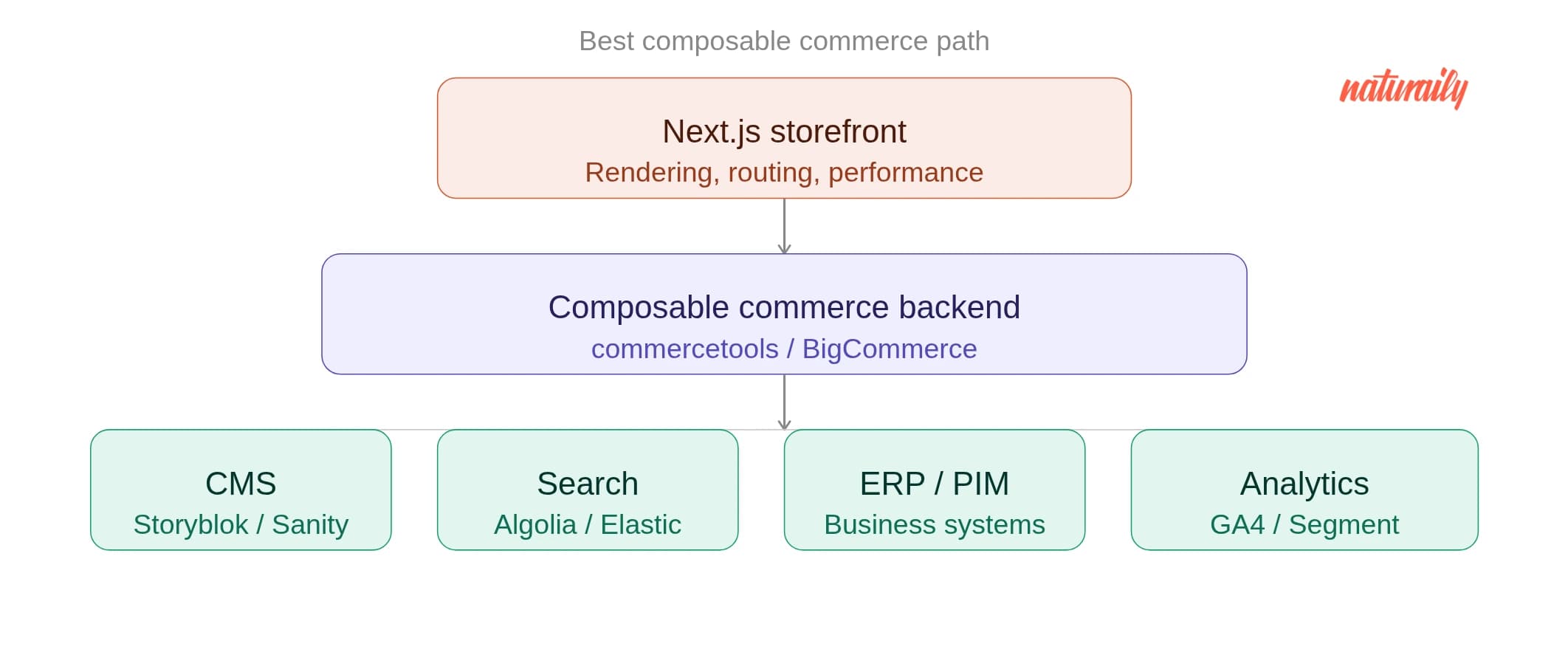
This pattern works because Next.js separates three concerns: frontend UX, commerce operations, and publishing workflows. The cost: implementation complexity and a frontend team that owns deployments, observability, and rendering strategy in-house.

Not sure whether to go headless or stay on a managed platform?
We help ecommerce teams work through exactly that decision – architecture, trade-offs, and what it costs to maintain long-term. No pitch, just a real conversation.
When Next.js is the right choice for ecommerce
SEO-sensitive ecommerce
Choose Next.js when:
organic search drives significant revenue,
category pages require strong indexing,
or the business depends heavily on content marketing.
SSR and ISR give you control over metadata rendering, crawlability, and page performance. That matters for large catalogs, long-tail category pages, and mobile-first indexing.
Content-heavy commerce
This is where Next.js separates from traditional themes. B2B ecommerce, editorial commerce, educational ecommerce, and brands that invest in SEO need CMS-driven landing pages, localization workflows, campaign publishing, and editorial flexibility. Traditional themes get restrictive fast.
Multi-market ecommerce
International storefronts compound complexity: localization, currency handling, regional SEO, edge delivery. Next.js handles these through middleware, App Router routing patterns, edge rendering, and granular caching controls.
When Next.js becomes the wrong choice
Going headless adds operational overhead. Many stores don't need that overhead. Skip Next.js if:
Your catalog is under 500 SKUs and rarely changes
Editorial workflows are limited to occasional blog posts
Organic search is not a primary acquisition channel
Your team lacks frontend infrastructure experience
Staying on Shopify or BigCommerce means accepting theme constraints in exchange for not running your own deployments, cache invalidation, rendering strategy, observability, and frontend maintenance. For many businesses, that trade is the right one. Most failed headless projects fail on operations before they fail on technology.
Next.js ecommerce architecture explained
The headless commerce market reached approximately $1.74 billion in 2025 and is projected to exceed $7 billion by 2032.
Modern ecommerce rarely operates as a single system anymore. Commerce increasingly spans:
CMS infrastructure,
personalization,
search,
analytics,
CRM,
ERP,
and omnichannel operations.
Next.js sits as the orchestration layer between these systems without forcing them into a single rendering model. That's why it became the default frontend for composable commerce.
Rendering strategy for ecommerce pages (SSR vs SSG vs ISR)
Different page types need different rendering strategies. Hybrid rendering combines SSR, SSG, and ISR across page types and is the standard production pattern. ISR earned its place because it gave teams static performance for category pages without requiring a full rebuild on every inventory change.
Recommended rendering strategy by page type
| Page type | Recommended strategy | Why |
|---|---|---|
| Homepage | SSG + ISR | Fast global delivery |
| Landing pages | SSG + ISR | SEO and cache efficiency |
| Category pages (PLP) | ISR | Better scalability and indexing |
| Product pages (PDP) | ISR + on-demand revalidation | Fresh inventory and pricing |
| Cart | Dynamic rendering | Accuracy matters more than caching |
| Checkout | Server-driven rendering | Security and transactional correctness |
| Customer account | SSR | Authenticated content |
| Blog/content hub | SSG + ISR | SEO scalability |
Revalidation patterns for ecommerce storefronts
Content changes at different rates. The right revalidation pattern depends on how often a page updates and how much staleness you can tolerate.
Time-based revalidation works well for pages that update on a predictable schedule – blog posts, editorial landing pages, or category pages that don't change with every inventory update. Set revalidate at the page or fetch level and Next.js handles the rest.
On-demand revalidation via webhook is the right choice for product and pricing data. When inventory or price changes in your commerce backend, a webhook fires and triggers revalidatePath() for the affected product page – no full rebuild, no waiting for a time interval to expire.
Tag-based invalidation using revalidateTag() is the most surgical option. Tag related content at fetch time (for example, all pages that depend on a specific product or collection), then invalidate by tag when that data changes. This is particularly useful for large catalogs where a single category update might touch dozens of pages.
The practical rule: use time-based revalidation as the fallback, webhook-triggered on-demand revalidation for commerce data, and tag-based invalidation when you need precision at scale.
Next.js App Router and what it changed for ecommerce
The App Router, introduced in Next.js 13 and stabilized in 14, changed how ecommerce storefronts handle data fetching, caching, and rendering at the component level. Before it, rendering decisions were made at the page level – the whole page was static, server-rendered, or client-rendered. App Router lets you mix rendering modes within a single page.
For ecommerce this matters in practical terms. A product page can server-render the core content for SEO while streaming in personalized recommendations client-side. A category page can statically generate the layout while fetching live inventory at the component level. Cache control moves closer to the data, not the route.
The tradeoff is complexity. App Router requires a clearer mental model of what runs on the server and what runs on the client. Teams that don't have that clarity tend to either over-render on the server (slower, heavier) or under-render (SEO gaps, hydration issues).
Why ISR matters for ecommerce
Before ISR, ecommerce teams picked between static performance or dynamic freshness. ISR lets them have both: pre-render pages at build time, then revalidate them on a schedule or via webhook when data changes. For a 10,000-SKU catalog, that's the difference between a 4-hour rebuild and a 30-second revalidation.
ISR works particularly well for:
Large product catalogs
Merchandising updates
Promotional campaigns
SEO-heavy category structures
A 2026 study found that ISR and SSG architectures achieved stronger CDN cache efficiency and lower origin compute load than SSR-heavy approaches.
Evaluating SSR, ISR, or fully headless architecture?
We help teams get ISR, SSR, and caching right before they ship, not after they've spent months debugging slow category pages and index drops.
Ecommerce SEO with Next.js
Next.js gives you SEO control and doing the SEO work is still on you. Three areas where teams lose ground:
Rendering architecture – serve indexable HTML on first paint or pay for it in crawl efficiency
Faceted navigation – filter URLs create crawl traps and duplicate content unless handled properly
Render parity – what bots see has to match what users see, or rankings drop
A previously mentioned 2026 study compared SSR, SSG, and CSR architectures and found that SSR and SSG implementations achieved earlier meaningful content visibility and more stable indexing outcomes than CSR-only approaches.
Ecommerce SEO checklist for Next.js storefronts
Technical SEO
Server-render indexable content
Control faceted navigation carefully
Generate structured data dynamically
Prevent crawl traps from filters
Segment large XML sitemaps
Maintain render parity between bots and users
Performance SEO
Reduce JavaScript aggressively
Stream non-critical UI selectively
Use ISR strategically
Cache predictable content at the edge
Monitor INP, LCP, CLS, and TTFB continuously
International SEO
Configure hreflang correctly
Localize metadata properly
Separate locale routing clearly
Prevent duplicate regional indexing
Platform options for Next.js ecommerce
Shopify headless
The most common headless setup today: Shopify backend, Next.js storefront, headless CMS (Storyblok, Sanity, or Contentful). This stack works well for SEO-heavy commerce, content-rich storefronts, and fast merchandising workflows.
Enterprise composable commerce
Commercetools-style architecture fits when organizations need extensive backend flexibility, multi-region commerce, complex integrations, or omnichannel orchestration. The flexibility is real. The implementation cost is also real, so expect 6 to 12 months for a first build and ongoing investment in platform integrations.
Open-source commerce
Medusa-style setups appeal to teams that want infrastructure ownership, backend extensibility, and lower platform lock-in. The trade: you run the commerce backend yourself, including scaling, security patches, and uptime.
Next.js commerce starter
Next.js Commerce is best understood as a reference storefront template. Use it to:
accelerate prototypes,
learn storefront architecture,
reduce initial setup work.
Production storefronts always need customization beyond what the starter provides. Treat it as a learning tool and prototype accelerator, not a production base.
We build for what comes after launch
Most storefronts hit a scalability wall six months in – slow deploys, fragile revalidation, unexpected SEO drops. We help you avoid that.
Performance and reliability: what actually affects conversion
Frontend performance affects ecommerce revenue directly. A 0.1-second speed improvement can increase retail conversions by 8%. Moving from a 1-second to a 5-second load time increases bounce probability by 90%.
Architectural decisions move conversion more than visual redesigns do. Edge delivery, image optimization, lightweight hydration, ISR-heavy rendering, and strict JS budgets are where the gains live.
UX, accessibility, and international growth
Strong commerce storefronts optimize for accessibility, mobile usability, and localization quality simultaneously. This matters because:
mobile dominates ecommerce traffic,
accessibility affects usability and compliance (WCAG 2.2, EAA 2025),
international expansion introduces performance variability fast.
Next.js supports these priorities through responsive rendering, streaming SSR, image optimization, and edge distribution. None of them happen by default. You have to configure them per project.
Real-world Next.js ecommerce examples (and what to copy)
FGS Global: Next.js + Storyblok + Algolia for a content-heavy global platform
FGS Global is a strategic communications firm operating across more than 25 offices worldwide. Their website functions as a primary business development tool, serving public visitors, employees, and external collaborators simultaneously. The scope has direct parallels in multi-audience ecommerce.When we rebuilt their platform in Next.js with Storyblok and a custom Algolia search layer, the core challenge was the same one most content-heavy ecommerce teams face: a legacy codebase with poor rendering strategy, a CMS that blocked editors instead of enabling them, and a search experience nobody could configure or control.
The results: the rebuild delivered 128 structured Storyblok components, migration of over 1,500 content items, and a three-tier access architecture for different audience segments – all on a Next.js + TypeScript foundation that the content team could operate without developer support.
What to copy: The component library approach. A structured block library in the CMS – not open-ended page building – is what gives editorial teams publishing speed without fragmenting the design system. Combined with a visual editor and approval workflows, it removed the developer bottleneck on content entirely. Ecommerce teams running campaign-heavy or editorial-driven storefronts should build the same way.
FGS Global
PR agency
FGS Global needed a fast, flexible platform that could support a complex global structure without sacrificing speed, SEO, or editorial workflows. We delivered a headless Next.js solution that keeps performance high and content operations efficient at scale.
5/5
Clutch review
Custom
search engine for faster content discovery
1500+
content items migrated without disruption

Capitalise: Next.js 15 + Storyblok replatform with A/B testing built in
Capitalise is a UK fintech platform helping small businesses access funding. Their old Pimcore-based website created the same friction ecommerce teams know well: slow pages, a CMS the marketing team worked around rather than through, and no ability to run experiments.
We moved them to Next.js 15 with Storyblok, Azure Front Door, and PostHog for A/B testing. The targets were specific: 90+ Lighthouse scores, sub-200ms page load response, and a CMS experience that gave the marketing team full independence.
The results: mobile LCP improved by 31%, average monthly traffic grew 48%, and content update time dropped 35%. The A/B testing infrastructure, which didn't exist in the previous setup, is now standard in how the marketing team makes decisions.
What to copy: The phased launch and the testing infrastructure. Capitalise launched in stages: new pages from Storyblok, legacy pages from Pimcore. Performance and SEO were validated before full cutover, which protects organic traffic during migrations. Building PostHog-based A/B testing into the platform architecture from day one (rather than retrofitting it later) is the right call for any conversion-focused storefront.
Capitalise
Business finance SaaS
Capitalise needed a modern website to replace their rigid legacy CMS and enable data-driven growth. We created a fast, headless platform with built-in A/B testing. Easy to experiment, optimize, and boost conversions.
48%
growth in average monthly traffic
31%
faster mobile LCP
35%
faster CMS content update

n8n: hybrid rendering at scale (300,000 pages)
n8n needed to generate hundreds of thousands of pages from multiple API sources without destroying build times or hitting rate limits. Their previous static generation approach capped them at around 2,000 pages.
We rebuilt the infrastructure on hybrid rendering, combining SSR and static generation, with a local caching layer that pre-fetched API responses during builds. The result: 300,000 dynamically generated pages, a 300% increase in monthly organic traffic over two years, and a 900% increase in top-10 keyword rankings within the first year.
(Note: n8n runs on Nuxt.js, but the architectural pattern translates directly to Next.js. The page generation challenge and caching approach apply to any hybrid-rendered storefront pulling from external APIs.)
What to copy: The local API caching pattern for external data sources. When your storefront pulls from multiple backends (product APIs, CMS, PIM, ERP) build a caching layer that normalizes responses and protects against rate limits during builds or revalidation. ISR-heavy Next.js storefronts hit this same problem at scale, and the same class of solution applies.
n8n
Workflow automation SaaS
n8n needed to generate hundreds of thousands of pages without sacrificing performance or visibility. We built a scalable, Nuxt.js-based architecture that supports high-volume, API-driven content while maintaining strong Core Web Vitals and SEO foundations.
5/5
Clutch review
300k
API-driven dynamic pages generated
900%
increase in Top 10 keyword rankings within 12 months

Why Next.js ecommerce architecture matters in 2026
Next.js works for ecommerce because of control over rendering, caching, and content workflows. Ease is not the selling point.
Teams that get the most out of Next.js make architectural decisions early: which pages use ISR, how revalidation triggers, where the CMS fits, and how much frontend complexity the team can own long-term.
We work with ecommerce teams designing and modernizing Next.js storefronts across Shopify, composable commerce, and headless CMS ecosystems. If you’re evaluating a build, migration, or storefront redesign, talk with our team to map out the architecture that fits your business.
FAQ
Next.js ecommerce explained
Next.js ecommerce means using Next.js as the storefront layer in a headless or composable commerce stack. It handles routing, rendering, and SEO while a separate backend (Shopify, commercetools, Medusa) handles transactions, inventory, and checkout. Teams pick it for control over rendering strategy, CMS workflows, and SEO that traditional themes don't offer.
Yes. Next.js supports SSR, SSG, ISR, streaming rendering, and structured metadata generation, which improves SEO control significantly. However, poor faceted navigation handling and excessive client-side rendering can still create serious SEO problems.
Use ISR for category pages, ISR plus on-demand revalidation for product pages, and SSR for authenticated or transactional experiences (cart, checkout, account). Hybrid rendering balances freshness, scalability, and performance better than any single-mode approach.
Hydrogen is stronger for Shopify-native simplicity. Next.js is usually stronger for composable architecture, CMS flexibility, advanced SEO, and broader integration ecosystems.
A standard setup includes: Next.js storefront, Shopify/commercetools/Medusa backend, headless CMS (Storyblok, Sanity, Contentful), search infrastructure (Algolia), analytics, and ERP/PIM integrations. Next.js sits as the rendering and orchestration layer.
Most teams combine: draft mode, preview URLs, webhook-triggered revalidation, cache tagging, and granular invalidation patterns. This allows content teams to publish quickly without rebuilding the entire storefront.
Build a storefront that scales
We design Next.js ecommerce architecture for teams that need it to last.