How to Choose an Ecommerce Website Design Company in 2026
The ecommerce website design company you pick decides how fast your store loads, how cleanly it converts, whether it survives a replatform without bleeding organic traffic, and what it costs you to run for the next three years. A good-looking storefront does not move revenue on its own.


Updated on June 15, 2026
Design is the visible layer. Underneath sit performance budgets, platform architecture, checkout logic, integrations, accessibility, and SEO. Get the partner right and those layers reinforce each other. Get it wrong and you pay for the same site twice.
U.S. retail ecommerce reached $326.7 billion in Q1 2026, 16.9% of all retail sales (U.S. Census Bureau, 2026). The storefront stopped being a brochure years ago. It is the channel. So the partner you hire is a revenue decision.
How do you choose the right ecommerce website design company?
Choose an ecommerce website design company by matching it to your biggest constraint (conversion, speed, platform fit, or integrations), then proving that fit against seven checks: an ecommerce-specific portfolio with metrics, platform depth, a UX and CRO process, Core Web Vitals targets, an SEO migration plan, an integration track record, and a real post-launch SLA.
In short:
An ecommerce website design company designs and builds online stores that convert, load fast, and scale across Shopify, Shopify Plus, and headless setups.
The strong ones tie design decisions to business outcomes: speed, conversion, SEO, and long-term maintainability.
Match the partner to your real bottleneck, not the prettiest case study.
An ecommerce website design company plans, designs, and ships the customer-facing storefront and the systems behind it. The best partners advise on whether to stay theme-based, redesign on Shopify, move to Shopify Plus, or go headless, then back that call with performance, SEO, and integration work.
Use the table below to map your primary need to what you should screen for.
| You need | Look for |
|---|---|
| Better conversion | UX, CRO, product-page and checkout expertise |
| A faster storefront | Core Web Vitals and frontend performance work |
| A Shopify redesign | Shopify and Shopify Plus design plus development experience |
| A headless storefront | Next.js, Hydrogen, headless CMS, API-first architecture |
| B2B ecommerce | ERP, PIM, CRM, account pricing, custom checkout logic |
| Long-term growth | Maintenance, analytics, experimentation, roadmap support |
Google Search Central confirms Core Web Vitals measure real-world experience and feed its ranking systems (Google). So performance belongs in vendor selection. Not after launch. Before you sign.
What does an ecommerce website design company do?
Modern ecommerce design covers far more than layouts and color. A full-service partner handles the work that decides whether the store sells:
ecommerce strategy and technical discovery,
UX/UI design,
conversion-focused product and collection pages,
responsive ecommerce web design,
frontend development,
Shopify, Shopify Plus, or headless architecture,
checkout UX,
ecommerce performance optimization,
Core Web Vitals optimization,
SEO migration,
structured data,
analytics and tracking setup,
CMS and content workflows,
third-party integrations,
accessibility checks,
post-launch maintenance and experimentation.
A product detail page affects variant selection, inventory visibility, page speed, SEO indexing, recommendation logic, analytics events, and conversion rate.
A checkout affects payment acceptance, fraud checks, shipping rules, tax calculation, B2B purchasing logic, and abandonment.
A navigation redesign can make or destroy organic equity if URL structures, internal links, canonical tags, and redirects are handled badly.
A studio that only delivers visuals leaves the revenue-critical layers to someone else. That handoff is where budgets and timelines tend to break.

One team for every layer
Design, checkout, performance, SEO, and integrations all decide whether your store sells, and the handoff between vendors is where they break. We build them together. Tell us what you are working with.
When should you hire an ecommerce website design company?
The trigger is rarely vanity. It is usually a number moving the wrong way, or a growth move the current store cannot support. Common moments to bring in a partner:
your storefront looks and behaves dated next to competitors
conversion rate has stalled or slipped
Mobile UX is clunky and mobile is most of your traffic
the site is slow and fails Core Web Vitals
you are migrating to Shopify or Shopify Plus
you are launching B2B ecommerce alongside DTC
you are expanding internationally with new currencies, languages, or tax logic
you want a headless or composable storefront
you need a redesign that does not torch existing SEO traffic
If two or more of these are true at once, the question is no longer whether to hire. It is who.
How to evaluate an ecommerce website design company before hiring
Vetting is where most buyers go soft. They scan portfolios, like the visuals, and skip the layers that carry the real risk. Work through these seven checks in order.
Check the agency’s ecommerce-specific portfolio
General web design and ecommerce are different sports. Ask for stores in your platform, your category, and your order volume. A gorgeous brochure-site portfolio tells you little about checkout flows, catalog scale, or integration depth.
Look for evidence of outcomes, not just screenshots: conversion lifts, speed gains, successful migrations. If every case study is a redesign with no metric attached, treat the silence as data.
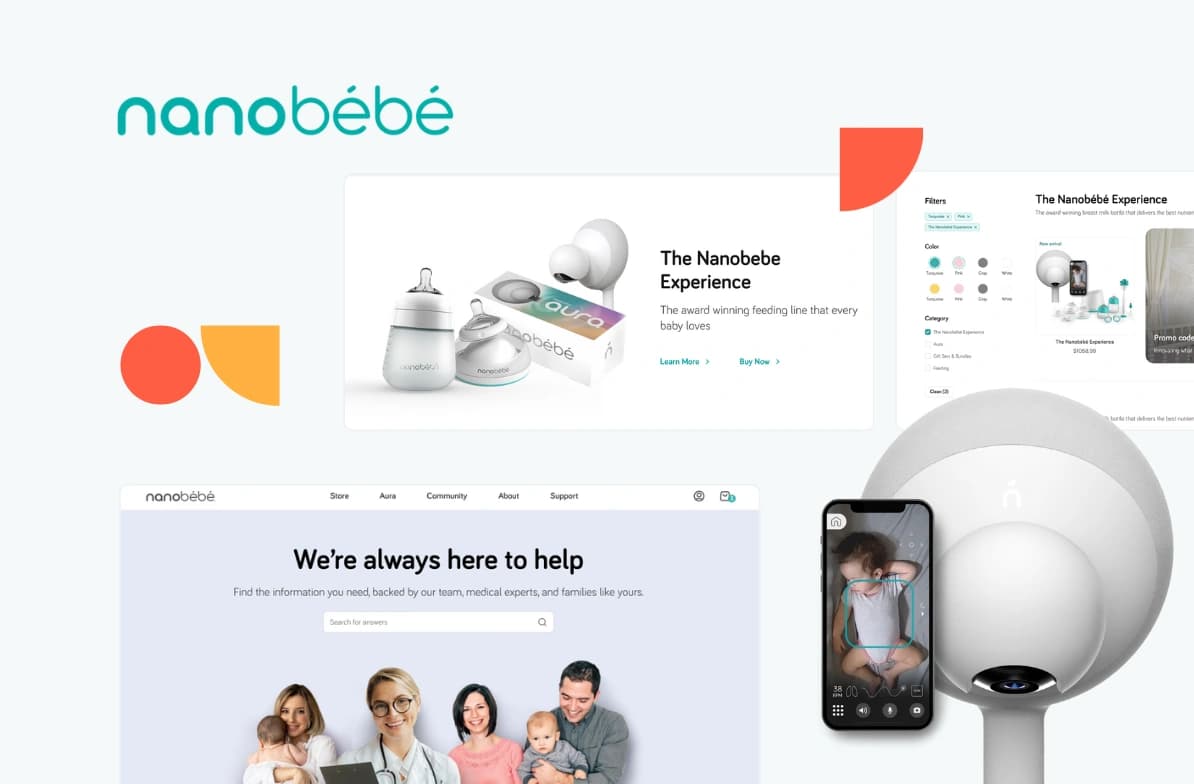
Nanobébé
Baby products e-commerce
Naturaily delivered a flexible headless commerce setup that made content management easier, supported product launches, and improved the online shopping experience.
5/5
Clutch review
117%
increased performance
80%
reduced TBT
Look for Shopify, Shopify Plus, and headless architecture expertise
The right architecture depends on your scale and roadmap, so the partner should hold real depth across the options rather than pushing one stack for every brief. Probe for hands-on experience with:
Shopify and Shopify Plus
Shopify Hydrogen and Next.js storefronts
headless CMS and composable commerce
ecommerce integrations and custom storefronts
Shopify is the safe default for a reason: merchants processed $162.6 billion in GMV in the first half of 2025, up 27% year over year (Shopify Form 10-Q, 2025). That momentum is why most SMB-focused agencies specialize there. Headless earns its keep at higher complexity, where a custom frontend and API-first stack unlock performance and flexibility a theme cannot.
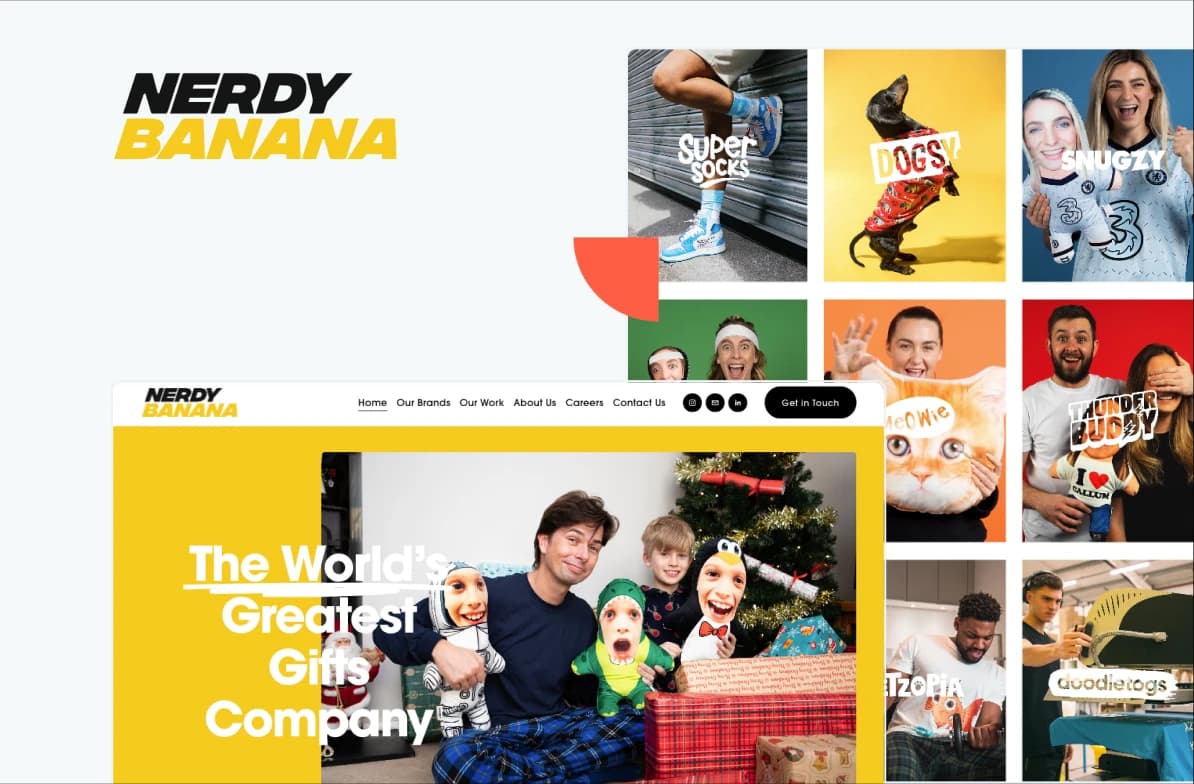
Nerdy Banana’s manual order processing hindered their efficiency and customer experience. Happily, we helped them increase conversion rates, delivery times, and sales.
3x
Quicker delivery times
95%
Production lead time saved
98%
Faster file preparation time
Evaluate ecommerce UX and conversion strategy
Design quality shows up in the checkout, the step where most carts leak. Across 50 studies the documented average cart abandonment rate sits at 70.22%, and the average U.S. checkout ships with 23.48 form elements against an ideal of roughly 12 to 14 (Baymard Institute, 2025). Ask any candidate how many fields their checkout will use and how they will test it. Agencies that only decorate go quiet at that question. The ones running CRO programs answer with field data.
Ask how they handle ecommerce performance and Core Web Vitals
Google describes Core Web Vitals as real-world user experience metrics for loading performance, interactivity, and visual stability. For ecommerce, that translates into practical questions: how fast does the product page load, how quickly can users interact, and does the layout shift while they are trying to tap a button?
Any ecommerce website design company you consider should be able to talk about Core Web Vitals without hiding behind vague “speed optimization” language.
This is especially important for Shopify and Shopify Plus builds, where apps, scripts, tracking pixels, personalization tools, reviews, subscriptions, loyalty widgets, and page builders can drag performance down.
Set the bar before work starts:
Set a sub-4-second load budget and explicit Core Web Vitals targets
Require server-side rendering or static generation for content and product pages
Ask for image, font, and third-party script budgets in writing
Demand before-and-after Lighthouse and field data, not lab scores alone
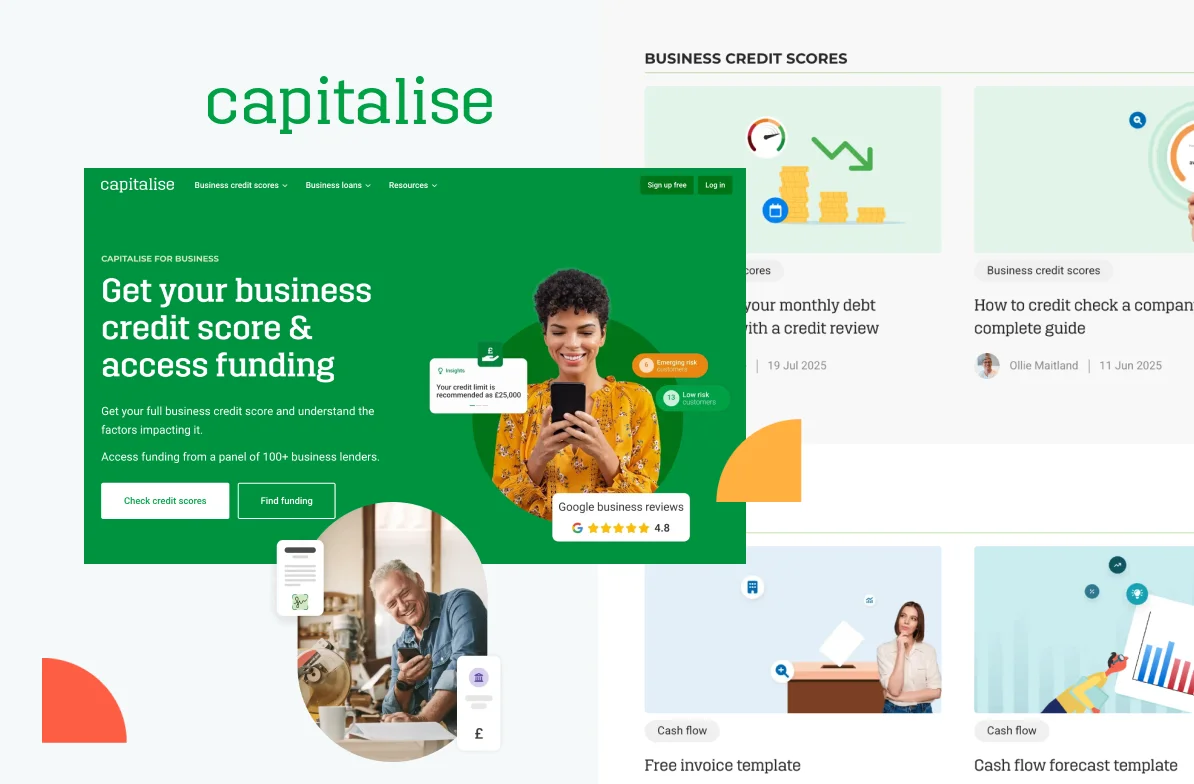
Capitalise
Business finance SaaS
Capitalise needed a modern website to replace their rigid legacy CMS and enable data-driven growth. We created a fast, headless platform with built-in A/B testing. Easy to experiment, optimize, and boost conversions.
48%
growth in average monthly traffic
31%
faster mobile LCP
35%
faster CMS content update
Ask how they protect SEO during an ecommerce website redesign
A redesign that loses rankings is a redesign that loses revenue. Organic equity built over years can evaporate in a launch weekend when redirects and structure are an afterthought.
When we replatform a store, we map redirects and preserve URL structure before the new site goes live, and we keep structured data intact so eligibility for rich results survives the move.
Confirm the partner does the same:
Redirect mapping completed and QA'd before go-live
URL structure and canonical strategy preserved or improved on purpose
Structured data and metadata migrated, not rebuilt from scratch
Crawl, index, and traffic monitored for weeks after launch
FGS Global
PR agency
FGS Global needed a fast, flexible platform that could support a complex global structure without sacrificing speed, SEO, or editorial workflows. We delivered a headless Next.js solution that keeps performance high and content operations efficient at scale.
5/5
Clutch review
Custom
search engine for faster content discovery
1500+
content items migrated without disruption

Check ecommerce integration experience: ERP, PIM, CRM, and payments
A storefront is only as stable as its connections to ERP, PIM, CRM, payments, tax, search, and marketing tools. B2B adds account pricing, quoting, and custom checkout rules on top.
Ask which integrations they have shipped, how they handle failures and retries, and who owns the connection after launch. Vague answers here predict expensive surprises later.
Check the agency’s process, QA, and post-launch support
The build is the start of the relationship, not the end. Clarify how they run discovery, design reviews, QA, and launch, and what support looks like once you are live.
Confirm there is a named maintenance plan, a real SLA, and a roadmap for experimentation and growth. A partner who disappears after invoicing will cost you more than they ever saved you.

Build it with a team that stays
Integrations, QA, and a real support roadmap are what keep a store healthy long after launch. We bake in a maintenance plan and a growth path from day one. Let us map yours.
Questions to ask before hiring an ecommerce website design agency
Bring these to the first serious call. The answers separate consultants from order-takers fast.
Show us two stores in our platform and category. What changed in conversion or revenue?
What Core Web Vitals and load-time targets will you commit to, and how will you prove them?
How many fields will our checkout use, and how do you test checkout UX?
Walk us through your redirect and SEO plan for the migration.
Which integrations have you shipped, and how do you handle failures in production?
What WCAG 2.2 AA conformance process do you follow?
What does support, maintenance, and the SLA look like after launch?
Red flags when choosing an ecommerce website design company
Some warning signs show up before the contract does:
portfolio is all visuals, no outcomes or metrics
one architecture is pitched as the answer to every brief
performance and Core Web Vitals are treated as a post-launch nice-to-have
SEO and redirects are not mentioned until you raise them
no accessibility process, despite 95.9% of homepages failing WCAG 2 in 2026
no clear support, maintenance, or SLA after go-live
pricing is a flat number with no drivers, scope, or assumptions
That accessibility figure is not a rounding error. The 2026 WebAIM Million found detectable WCAG 2 failures on 95.9% of the top million homepages, with low-contrast text the most common barrier at 83.9% (WebAIM Million, 2026). An agency without an accessibility process is shipping legal and conversion risk into your store.
Ecommerce website design company vs ecommerce development company
The labels blur, and that ambiguity costs buyers real money when they hire the wrong shape of partner. Here is the practical split:
| Partner type | Best for | Watch out for |
|---|---|---|
| Design studio | Visual identity, UX/UI, brand refresh | May lack ecommerce engineering, SEO migration, and integration depth |
| Ecommerce web design agency | UX/UI, storefront design, responsive ecommerce web design, conversion-focused templates | Quality varies; some stop at design and outsource development |
| Ecommerce development company | Storefront implementation, integrations, performance, backend logic | May need UX strategy or brand design support |
| Shopify Plus design agency | Shopify Plus, checkout customization, B2B, migration, Shopify ecosystem | Not always strong in headless, complex CMS, or non-Shopify architecture |
| Headless ecommerce agency | Custom frontend, headless CMS, API-first architecture, composable commerce | Can overcomplicate projects that a strong Shopify build could handle |
| Full-service ecommerce partner | Strategy, UX, design, development, integrations, maintenance | Usually costs more, but reduces handoff risk |
If your bottleneck is brand and look, a studio fits. If it is checkout, scale, or systems, you want development depth. If you want one team accountable end to end, a full-service partner removes the handoff risk entirely.
How much does ecommerce website design cost?
Be wary of anyone quoting an exact figure before scope exists. A serious quote before discovery is a guess; real pricing tracks the drivers behind the build. Cost usually depends on these drivers:
| Cost driver | Why it changes the budget |
|---|---|
| Project type | UX audit, redesign, theme build, replatforming, or headless rebuild require different teams and timelines |
| Platform | Shopify, Shopify Plus, BigCommerce, commercetools, Magento/Adobe Commerce, or custom architecture have different implementation demands |
| Design scope | Homepage-only refresh costs far less than a full design system and template library |
| Catalog complexity | Large catalogs, variants, filters, bundles, subscriptions, and personalization increase UX and development work |
| B2B logic | Account pricing, company profiles, payment terms, permissions, and custom checkout rules add complexity |
| Integrations | ERP, PIM, CRM, OMS, WMS, search, loyalty, and analytics integrations require planning and QA |
| Migration risk | URL changes, content migration, SEO preservation, and analytics continuity add necessary work |
| Performance requirements | Core Web Vitals optimization, monitoring, and script governance require engineering discipline |
| Accessibility | WCAG-aware design, QA, and remediation should be planned, not bolted on |
| Support model | Post-launch maintenance, optimization, and experimentation affect total cost of ownership |
Skilled build talent is expensive. U.S. web developers and digital designers earned a median $95,380 a year in 2024, close to double the median across all occupations (U.S. Bureau of Labor Statistics). That helps explain why strong ecommerce delivery teams do not price like commodity vendors.
How to shortlist an ecommerce website design company
Before you contact agencies, define the project clearly enough to avoid vague proposals. Use this checklist.
Prepare your ecommerce redesign requirements before outreach
Define current business problems.
List target outcomes.
Pull conversion, revenue, traffic, and Core Web Vitals baselines.
Identify top organic landing pages.
Document current platform constraints.
List integrations and data flows.
Define must-have launch features.
Define what can wait.
Identify internal owners for content, design feedback, analytics, and technical decisions.
Ask each ecommerce agency for evidence, risks, and delivery details
Relevant ecommerce case studies.
Similar Shopify, Shopify Plus, B2B, or headless examples.
Architecture recommendation.
UX and CRO process.
Performance approach.
SEO migration workflow.
Integration experience.
Accessibility process.
Team structure.
Post-launch support model.
Risks they see in your project.
The strongest proposals do not say yes to everything. They point out constraints, which is a good sign. A partner who challenges the brief may save you from an expensive wrong turn.
Which ecommerce website design company should you choose?
For ecommerce teams, the hard part is rarely “making the store look better.” It is deciding what should change, what should stay stable, and where the current storefront is holding growth back.
That is where Naturaily can help. We work with brands that need ecommerce design to connect with architecture, performance, SEO, and maintainability, whether that means improving an existing Shopify store, moving to Shopify Plus, or planning a headless storefront with Hydrogen or Next.js.
If your store is starting to feel like a constraint instead of a growth channel, contact Naturaily. We can help you assess whether you need a redesign, a platform upgrade, or a focused optimization roadmap before you commit budget to the wrong solution.
FAQ
Choosing an ecommerce website design company
Choose an ecommerce website design company by checking ecommerce-specific portfolio, platform expertise, UX and CRO process, Core Web Vitals knowledge, SEO migration workflow, integration experience, and post-launch support.
Do not choose based on visuals alone. Ecommerce storefronts depend on product discovery, checkout UX, performance, analytics, SEO, and backend systems. The best agency should ask about revenue, conversion, traffic, integrations, catalog structure, and operational constraints before proposing a solution.
An ecommerce website design company should plan, design, build, and optimize storefronts that support conversion, speed, SEO, and business operations.
That usually includes UX/UI design, responsive ecommerce web design, product and collection page design, Shopify or Shopify Plus development, headless ecommerce website design, performance optimization, SEO migration, analytics setup, integrations, accessibility checks, and post-launch support.
An ecommerce design agency usually focuses on UX, visual design, branding, and storefront experience, while an ecommerce development company focuses on implementation, integrations, performance, platform logic, and technical delivery.
For serious ecommerce projects, the strongest partner often combines both. Design without engineering can create concepts that are hard to build. Engineering without UX can produce a technically stable store that fails to convert.
Ecommerce website design cost depends on scope, platform, design depth, catalog complexity, integrations, migration risk, performance requirements, and support needs.
A light Shopify redesign costs much less than a Shopify Plus, B2B, or headless ecommerce build with ERP, PIM, CRM, CMS, search, and internationalization. Avoid fake universal pricing. Ask agencies to explain cost drivers, assumptions, risks, and what is excluded from the quote.
Choose a Shopify agency when Shopify or Shopify Plus can support your catalog, checkout, content workflows, integrations, and growth plans without excessive workarounds.
Choose a custom or headless ecommerce agency when you need more frontend control, advanced content modeling, complex integrations, multi-market flexibility, or custom UX that standard themes cannot support cleanly. Ask a sharper question: what is the simplest architecture that supports the business?
Choose a headless ecommerce agency when your storefront needs more flexibility than a traditional theme can provide, especially around performance, content workflows, localization, custom UX, or complex integrations.
Headless can work well with Shopify Plus, Hydrogen, Next.js, and a headless CMS. But it is not the default right answer.It increases engineering ownership, maintenance demands, and architectural complexity. Use it when the business case justifies the extra control.
Core Web Vitals are important because they measure real-world user experience across loading performance, interactivity, and visual stability.
For ecommerce, poor performance can hurt product discovery, checkout confidence, mobile usability, and SEO visibility. A serious ecommerce website design company should define performance budgets before development and test product, collection, cart, and checkout flows, not just the homepage.
Ask about ecommerce case studies, platform experience, UX process, Core Web Vitals targets, SEO-safe redesign workflow, integration experience, accessibility process, team structure, QA, analytics validation, and post-launch support.
Also ask what they would not recommend for your project. Strong agencies will talk you through the trade-offs; weak ones agree with everything in the brief.
An agency protects SEO during an ecommerce redesign by auditing the current site, identifying high-value pages, preserving or mapping URLs, setting redirects, maintaining metadata, validating canonical tags, protecting structured data, preserving internal links, and monitoring Search Console after launch.
SEO migration should happen before launch. Not after rankings drop.
Red flags include visual-only proposals, no ecommerce case studies, no Core Web Vitals process, no SEO migration plan, no integration experience, vague post-launch support, guaranteed revenue promises, and architecture recommendations made before discovery.
Another major red flag is a headless recommendation without a clear business case. Headless can be powerful, but unnecessary complexity is still complexity.
Not sure what your store actually needs?
Redesign, replatform, or focused optimization. The right move depends on where your storefront is quietly limiting growth, and we will help you find it before you spend on the wrong fix.